
Voice Is Back as a Key Channel for Customer Engagement
The earliest form of communication is now one of the hottest ways to engage customers. Here’s how we came full circle — and where the technology is headed next.


Key Takeaways
- Voice is back as one of the hottest ways to engage customers, powered by large language models and natural language processing.
- AI voice tools handle real-time transcription, multilingual translation, fraud detection, and agentic customer service.
- By 2028, 70% of customers are expected to start their service journey through a conversational AI interface.
Voice is back. Not long ago, voice technology was all but dismissed as a legacy communications channel in the era of AI and instant messaging.
But now, after spending years in the shadows while AI surged, voice is suddenly one of the hottest ways to engage customers and search for information. And AI — the very tool we once thought would replace voice — is ironically responsible for voice’s comeback, along with the advancement of network APIs, machine learning, and natural language processing technologies.
Voice is becoming a strategic source of intelligence, context, trust, and automation. Entirely new companies and business models are being built around the premise that voice will be a primary way we interact with technology. And the tools may eventually become so strong that we lose the need for a keyboard altogether.
"Voice was never really gone — it just needed AI to unlock its full potential. Now, with generative AI, network APIs, and natural language understanding converging, voice has become the most powerful channel in the customer engagement stack,” said Steven Giuffre, expert product marketer at Vonage who works on voice technologies.
“It's not just about making calls anymore; it's about creating intelligent, personalized conversations that meet customers exactly where they are," he added.
Mila D’Antonio, principal analyst, customer engagement, at Omdia, recently asked companies how their interaction channels had changed in the previous year. About 44% said they were using more conversational chatbots, 45% used more AI-powered voice assistants, and 30% reported growth in conversational IVR systems. The results show how enterprises are rethinking customer engagement in the post-chatbot era, D’Antonio wrote in a recent report.1
1 "Market Landscape: Conversational AI 2025 — From Assistants to Agentic," published Sept. 12, 2025, author Mila D'Antonio
When did voice technology get so good?
First things first: We aren’t talking much about standard telephony when we talk about voice nowadays. Telephony was the hot new thing in the 1800s, but now voice innovation has expanded across video meetings, video doorbell conversations, in-app chats on your phone, and more.
Many of these scenarios use voice APIs, which are flexible software interfaces your company can use to create better conversations and closer relationships with customers. With voice APIs, for example, you can build high-quality voice applications in the cloud, or embed modern voice calling services into an existing app or website.
Say you’re using a company’s app to check on an order. If you can’t find what you need, a voice API lets you use a click-to-call feature within the app to talk to someone instead of searching around for the customer service voice number.
"Customers don't want to leave the app they're already in to get help — and they shouldn't have to,” Giuffre said. “Embedding voice directly into the app experience removes friction, adds context, and creates a far more trusted interaction. That's the shift we're seeing: from dialing a number to clicking a button and being instantly connected, with all the intelligence of the app behind it."
Also developing quickly is AI voice. According to business and technology insights organization Gartner®, “translation, text-to-speech (TTS), and speech-to-text (STT) are three distinct but related technologies in the field of natural language processing of human voice, often packaged together as ‘Voice AI’ in the realm of conversational AI (CAI).”2 Those elements are integral to speech recognition tools where machine learning and natural language processing intersect.
Voice capabilities really took off with the development of large language models that can respond to user questions with information from the internet or other data sets. Now, people have ongoing voice conversations with ChatGPT or other LLMs, skipping the keyboard altogether because LLM comprehension and voice technologies are so good.
2 Gartner, “Top Trend in 2026: Voice AI Enhances CX With New Use Cases,” published Aug. 13, 2025, author Manoj Bhatia. GARTNER is a trademark of Gartner, Inc. and/or its affiliates.
How are companies using voice now?
In some ways, voice is coming full circle back to the way we originally communicated.
“We as humans have used voice forever because it simply is the way we trust and we love to communicate,” said Fabio Cerone, managing director of the TELCO Business Unit EMEA at Amazon Web Services, in a recent talk with incoming Vonage CEO Christophe Van de Weyer. “I think we are going through a renaissance of voice in the way we can interact with customers.”
Remember the days when you’d call a company and press 1 for sales, press 2 for service, and so on — only to get stuck at a dead end? Customers hanging up in frustration is a damaging scenario for a company, and AI voice technologies have already made tremendous progress to avoid that. Now, many companies simply ask callers why they’re calling and what they want to do.
“If you want to build trust with your customers, you need to interact,” Cerone said. “You want to change and shift this reactive awful moment to a proactive moment of love. Solving the issue and engaging for new things. This is the business case.”
For enterprises, it’s imperative to respond in near real time to both customers and employees. Voice is a crucial part of this shift, experts say, because it captures intent, emotion, urgency, and context.
Gartner sees five top use cases for AI Voice:3
- Real-time transcription
- Accurate multi-lingual translation
- Compliance recording and analytics in financial services and healthcare industry
- AI scribing in healthcare
- Voice frauds and deepfake audio detection
Other use cases at companies include free-form voice, where you can talk to an AI therapist or search for information with ChatGPT, and AI-powered education, where you would follow a defined learning course.
The early days of AI voice technology focused on routing, IVR, and transcription, according to the CPaaS Acceleration Association in a recent report.4 But now, companies are testing more complex capabilities, such as biometrics, booking, and agentic service interactions.
"Over time, value will come from both better real-time interactions and the deeper analysis and governance of conversations,” said Andrew Collinson, research director for the association. “Near-term wins will be in better existing business results. Longer-term benefits will be built on new strategic insights derived from the mass and richness of newly accessible voice data, opening new service and competitive opportunities."
3 Gartner, “Top Trend in 2026: Voice AI Enhances CX With New Use Cases,” published Aug. 13, 2025, author Manoj Bhatia
4 CPaaSAA, “AI Voice: Who Will Run the Conversation?,” published March 2026
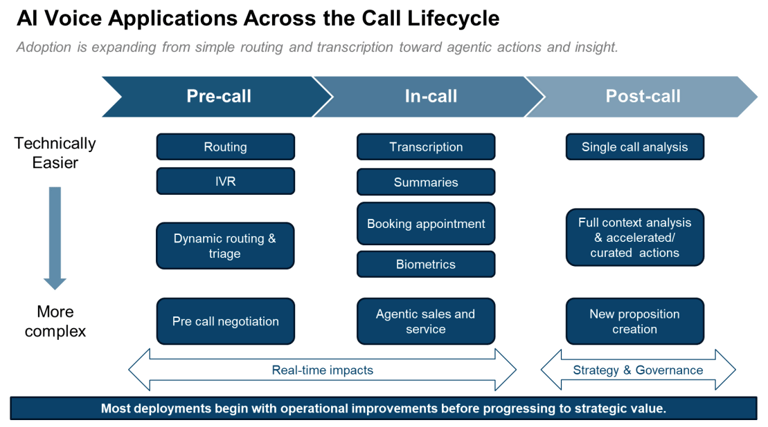
Image source: “AI Voice: Who Will Run the Conversation?” report by CPaaSAA.
Vonage brings voice flexibility and integration
Here are six ways Vonage is working on the future of voice:
24/7 customer service
Vonage Voice API allows businesses to be reachable at any hour of the day, with support for 120 languages so customers can get service in their preferred language.
Instant answers
Vonage APIs help customers use self-service tools to get the information they need. If a live agent is needed, a combination of sentiment analysis and the proprietary Vonage NLU engine can help route a call through to the right person or schedule a call back as needed.
Branded calling
This tool identifies a company calling you right from your phone’s lock screen. So if your doctor’s office is calling you with test results, the office name, logo, and the reason for calling display on your screen while the call comes in.
Automatic speech recognition
This Vonage API adapts to real-world speaking patterns and accents so that customers can use self-service chats to get what they need. It also enables voice authentication and accurate transcription, and scales easily for any business size.
Analyzing conversations
Vonage AI can transcribe and analyze conversations to learn more about the customer. This interaction data can integrate into CRM or BI reporting tools, giving business leaders a deeper level of insight into what customers are thinking and how they’re reacting. In the long run, it could even help companies upsell and better target customers according to their needs.
Integration with Salesforce
Vonage combines voice calling with Salesforce’s CRM platform, so businesses can give their agents real-time data and insights directly within the Salesforce interface.
What’s the future of voice technologies?
“By 2028, at least 70% of customers will use a conversational AI interface to start their customer service journey,” according to recent research from Gartner. 5
There will be deeper integration of voice capabilities across apps and platforms. What if you could make free international calls from the Alexa device in your kitchen? What if your watch was always listening, and responded to your daily interactions with useful tips and information? Robotics is another area where voice will play a major role in the future.
This year, conversational AI will start to evolve from simple scripted chatbots and voice assistants, according to D’Antonio, the analyst at Omdia. The market is shifting to autonomous AI agents that can handle entire customer journeys and business processes from start to finish. “These next-generation agents will not just answer questions; they will anticipate needs, trigger workflows, and escalate issues only when human judgment adds value,” D’Antonio wrote in a recent report.6
Picture an end-to-end business process performed directly from chat or voice. That leads to faster cycle times, higher satisfaction, and lower overhead, D’Antonio added.
"The future of voice isn't just about being heard — it's about being recognized, trusted, and relevant,” Giuffre concluded. ”When you combine branded calling with AI-driven conversations and real-time data, every voice interaction becomes an opportunity to deepen the customer relationship. That's the bar businesses need to be reaching for, and the tools to get there are available right now."
5 Gartner, “Top Emerging Trends in AI Chatbots and IVRs for 2025,” published May 16, 2025, authors Ian Elliott and Daniel O’Sullivan
6 "Market Landscape: Conversational AI 2025 — From Assistants to Agentic," published Sept. 12, 2025, author Mila D'Antonio
Frequently asked questions about voice and customer engagement
Turns out, voice never really went away — AI just finally gave it the upgrade it needed. Today's voice tools can hold natural, personalized conversations in 120+ languages, and by 2028, 70% of customers are expected to start their service journey through a conversational AI interface.
Think of a voice API as a plug-and-play tool that lets you add smart voice features — like click-to-call or automated support — directly into your app or website. Instead of making customers search for a phone number, you bring the conversation to them, right where they already are.
AI voice has come a long way from "press 1 for sales" — companies are now using it for real-time transcription, multilingual translation, healthcare scribing, fraud detection, and even end-to-end agentic customer service. If there's a conversation happening in your business, there's probably an AI voice tool that can make it smarter.
Vonage Voice API covers the full spectrum — from 24/7 multilingual self-service and intelligent call routing to Branded Calling, automatic speech recognition, and conversation analytics. It also integrates directly with Salesforce, so your agents always have the context they need right at their fingertips.
Voice is heading toward a world where AI agents can handle entire customer journeys on their own — anticipating what you need, taking action, and only looping in a human when it truly matters. As Steven Giuffre from Vonage puts it: "The future of voice isn't just about being heard — it's about being recognized, trusted, and relevant."