Customer Engagement Messages: The 2026 Guide to Messaging That Converts and Retains
Customer engagement messaging has evolved from plain text into rich, interactive, two-way conversations across channels like RCS, WhatsApp, and MMS. In 2026, businesses can no longer rely on SMS and email alone. To stand out in crowded inboxes and notification trays, brands must create conversations, not just notifications.
Why 2026 is the turning point for customer engagement messaging
The average U.S. smartphone user receives 46 app push notifications every day. Add in SMS, WhatsApp, RCS, and email, and the total climbs to around 75 daily notifications per person, or more than 285 billion notifications sent worldwide every day.
The problem is simple: Most messages are ignored.
This is where the best conversational messaging platforms for customer engagement in 2026 make the difference. Rich business messaging turns alerts into trusted, actionable conversations that capture attention.
From notifications to conversations
The shift in messaging is not only technical; it’s psychological. Customers now expect interactions that feel like conversations. They want to:
Interact rather than receive one-way alerts
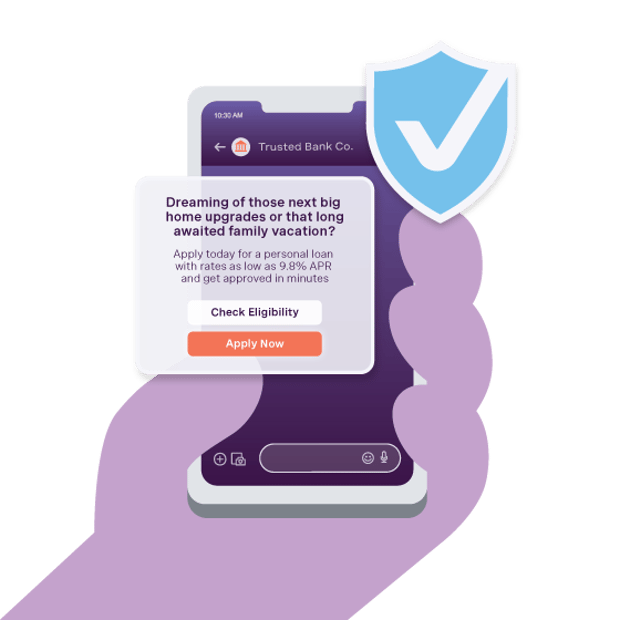
Trust branded, verified senders
Take action instantly with carousels, buttons, and rich visuals
Traditional SMS and email rarely meet these expectations. By contrast, RCS, WhatsApp, and MMS create what analysts describe as zero-click customer experiences, where users can act without leaving the thread.
Why customer engagement messages must evolve
Being mobile-first no longer means sending plain text. Customers now expect:
Interactive onboarding journeys
Personalized offers tied to their history or behavior
Order updates with branded visuals
Appointment confirmations that include maps
Promotions that are secure and delivered in real time
The future is not about sending more. It is about sending smarter customer engagement messaging through the platforms people already trust.
What is conversational messaging?
Conversational messaging is the opposite of a spam blast. It delivers two-way, natural interactions and integrates with CRMs, analytics, and automation.
For example:
Notification: “Your order shipped.”
Conversation: “Hi Tom, your order is on its way. Tap below to track your package or message support if you have a question.”
This simple shift creates a relationship. When scaled, conversational messaging drives engagement, loyalty, and measurable results.
Unification is leading this messaging shift
Vonage has become one of the leading messaging platforms for customer engagement by unifying major channels into a single programmable framework. Vonage Messages API provides:
One API for RCS, WhatsApp, SMS, MMS, Messenger, Viber, and in-app chat
Built-in failover to SMS when RCS is unsupported
Real-time delivery and engagement analytics
Verified senders and JWT authentication for security
Global reach across billions of users
This is not just another communications API. It is the backbone powering some of the most effective customer engagement campaigns in 2026.
Best conversational messaging platforms for customer engagement in 2026
Whether in retail, SaaS, financial services, or ecommerce, the right platform should excel in five areas.
1. Two-way messaging that feels like a real conversation
One-way SMS alerts no longer work. Customers expect short, natural exchanges like those on WhatsApp or iMessage.
The best platforms:
Automatically reply with relevant details
Escalate complex cases to live agents
Personalize replies based on customer history
Example: A customer asks “Where is my order?” Instead of a generic reply, the system instantly sends a live tracking map.
2. Rich multimedia content that captures attention
Plain text is easy to ignore. Rich business messaging powered by MMS, RCS, and WhatsApp makes messages more engaging:
MMS supports images, audio, and video clips, ideal for U.S. campaigns
RCS delivers branded layouts, carousels, and clickable buttons inside Android’s native messaging app
WhatsApp integration allows secure, media-rich global communication, including PDFs, links, and forms in a single thread
3. Engagement analytics that go beyond open rates
Delivery receipts are not enough. Effective platforms provide analytics such as:
Click-through and conversion rates
Read receipts and reply behavior
Time-to-first-response metrics
4. APIs and chat app integration for flexibility and scale
Your messaging platform should integrate with CRMs, apps, and websites.
Vonage Messages API provides:
Single integration for RCS, WhatsApp, SMS, MMS, Messenger, and more
Automatic fallback from RCS to SMS
Webhook support for real-time analytics
Example: A campaign designed in RCS automatically falls back to SMS for unsupported devices, ensuring no customer is left out.
5. Security, compliance, and reliability you can trust
Customers want assurance that data and conversations are secure. Look for:
Verified sender identities with branding
JWT-secured API calls
Fraud detection and blocking
GDPR and TCPA compliance
Vonage’s security and compliance features give businesses like Confer With the confidence to expand customer engagement without compromising trust or regulatory standards.
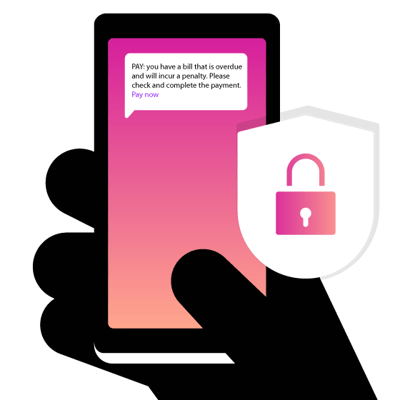 Fight messaging fraud with Vonage Fraud Defender
Customer engagement messaging with rich business messaging
If you want a customer engagement messaging platform that delivers more than delivery receipts, Vonage stands out. This is not a basic SMS tool but a programmable, enterprise-grade infrastructure designed for scale.
One messaging API for every channel
Channels include:
RCS
SMS and MMS
WhatsApp Business
Messenger
Viber
In-app messaging
With fallback built in, messages always reach the customer.
Personalized, interactive messaging at scale
Vonage supports:
MMS promotions with visuals and PDFs
RCS onboarding flows with buttons
WhatsApp notifications with secure links
Broadcast rich media by behavior or location
Example: An airline confirms a booking with an RCS itinerary, a “Check In” button, and a map. Other customers receive WhatsApp or SMS versions automatically.
Built-in security and verified senders
Vonage strengthens trust with:
Verified brand identities
Fraud Defender for suspicious activity
JWT-secured APIs
Signed callbacks for tamper-proof reporting
This ensures every interaction is both authentic and compliant.
Engagement analytics and message performance data
With Vonage, you can track:
Deliverability by channel and carrier
Read receipts and replies
Link clicks, taps, and conversions
ROI by campaign
These insights allow teams to optimize in real time.
Real results from Vonage customers
Guest Connect
Reduced operational costs by consolidating messaging tools
Positioned for expansion across nine markets
mydealz
Adopted Vonage RCS to pioneer rich media deal alerts in Germany
Sent branded product alerts with buttons
Improved retention and engagement rates
Confer With
Leveraged Vonage Video and Messaging APIs to deliver immersive, branded customer experiences
Increased conversion rates by up to 30% and achieved an NPS above 80
Reduced product returns by 30% with post-purchase video follow-ups and rich messaging
Boosted average order value by 50% compared to traditional ecommerce channels
Increase customer interactions with MMS, RCS, and WhatsApp
MMS remains effective in North America for visuals and promotions, with retailers seeing up to 3x higher click-through rates compared to SMS.
RCS provides branded, interactive messaging within Android’s native app, complete with verified business profiles, carousels, and buttons. Example: FREENOW confirms rides with driver photos, vehicle details, and live maps in-message.
WhatsApp, with more than 3 billion users, is essential for global reach. Its end-to-end encryption makes it a secure choice for alerts and promotions. Example: Banks use WhatsApp for fraud alerts, letting customers confirm transactions instantly.
Programmable messaging APIs for engagement at scale
Messaging APIs unify channels and enable automation:
One API for RCS, SMS, MMS, WhatsApp, Messenger, and Viber
Personalization tied to CRM data
Automation for alerts, campaigns, and chatbots
Real-time analytics and fraud monitoring
Example: A financial services provider sends instant fraud alerts on WhatsApp with “Confirm” and “Flag” buttons, reducing risk and support costs.
Solving customer engagement content creation barriers
Teams often struggle with:
Limited design resources
Balancing message quality with frequency
Managing multiple channels
Skill gaps across teams
Lack of analytics
Vonage addresses these with templates, automation, APIs, low-code tools, and detailed reporting.
Collecting engagement data from messaging
Just like digital ads, messaging needs metrics. Make sure you are tracking:
Delivery rate
Opens and reads
Click-throughs
Response rates
Conversions
Which messaging platform is best for engaging customers in 2026?
The right choice balances reach, personalization, analytics, and compliance.
Multichannel delivery with fallback
Personalized, automated, two-way messaging
Analytics beyond delivery confirmations
Verified security and compliance
Developer APIs and marketer-friendly tools
How to improve user engagement with multimedia messaging
Trend 1: Conversational commerce
Shoppers buy directly inside RCS and WhatsApp threads.
Trend 2: AI-driven personalization
AI generates recommendations and predictive flows.
Trend 3: Zero-click experiences
RCS and WhatsApp allow actions inside the message, no redirects.
Trend 4: Blended human and AI conversations
Bots handle FAQs, while agents join for complex issues.
Trend 5: Compliance by default
Platforms must support GDPR, TCPA, and PSD2 with verified business IDs.
Personalized customer messaging inspires action
The future of customer engagement messages is rich, interactive, and data-driven. The winners will not be those who send the most messages but those who send the right ones at the right time.
Vonage unifies RCS, WhatsApp, and MMS into one programmable platform, delivering personalization, analytics, and compliance at scale.
Start today engaging users with RCS, WhatsApp, and MMS content.
Sign up now
Was this helpful? Let's continue your API journey
Don't miss our quarterly newsletter to see how Vonage Communications APIs can help you deliver exceptional customer engagement and experiences on their favorite channels.

Thanks for signing up!
Be on the lookout for our next quarterly newsletter, chock full of information that can help you transform your business.
Still have questions about customer engagement messages?
Customer engagement messages are communications sent through channels like SMS, MMS, RCS, and WhatsApp. Unlike simple notifications, they are designed to build trust, encourage interaction, and increase retention. Examples include order updates with clickable buttons, promotional alerts with product images, and two-way conversations that let customers confirm appointments or ask questions in real time. This type of rich business messaging helps brands deliver better user experiences that feel personalized and interactive.
The best conversational messaging platforms in 2026 combine multichannel delivery (RCS, MMS, WhatsApp, and in-app chat) with automation, analytics, and security. They should integrate seamlessly with CRMs and apps, provide fallback when RCS is not supported, and offer verified business messaging to protect users. Vonage is a strong choice because the company’s Messages API unifies every major channel, provides built-in compliance, and makes personalized customer engagement messaging scalable.
Yes. RCS goes beyond SMS by supporting branding, images, carousels, buttons, and verified sender IDs. This creates richer, more interactive experiences.
WhatsApp is one of the most powerful tools for global engagement. With more than 3 billion users worldwide, it allows businesses to deliver secure, media-rich messages that include PDFs, images, videos, and forms. Brands use WhatsApp for fraud alerts, onboarding guides, personalized promotions, and two-way conversations that make customer support instant and interactive.
Success is measured using engagement analytics. Important metrics include:
Delivery rate (shows reliability)
Open and read receipts (shows attention)
Click-throughs on links or buttons (shows interaction)
Response rates for two-way messaging (shows engagement)
Conversion rates (proves ROI)
Advanced platforms like Vonage also provide campaign-level ROI tracking, fraud detection, and integration with CRMs and marketing automation tools.
Yes. Rich business messaging is no longer limited to enterprises. Small businesses can use prebuilt templates, low-code tools, and automated messaging to create professional, multimedia campaigns without large teams or developer resources. This levels the playing field, allowing local retailers, service providers, and startups to engage customers with the same interactive messaging strategies as global brands.
Examples include:
An RCS boarding pass with a live map for airline passengers
A WhatsApp coupon with a “Redeem Now” button for an ecommerce store
An MMS video tutorial for SaaS onboarding
A secure two-way fraud alert from a bank
These messages combine personalization, interactivity, and trust, leading to higher engagement.
Messaging APIs make it possible to unify multiple channels like SMS, MMS, RCS, and WhatsApp under one framework. This reduces technical complexity and ensures consistent messaging across platforms. APIs also support programmable messaging, enabling businesses to personalize content, trigger automated flows, and access real-time analytics. A messaging API is essential for scaling engagement campaigns without sacrificing quality.
Engagement analytics show how messages perform beyond delivery confirmations. They reveal open rates, clicks, replies, and conversions, helping marketers test, learn, and optimize campaigns. For instance, if one version of an MMS coupon drives twice the clicks of another, analytics provide the insight needed to scale the better option. Over time, this data-driven approach makes customer engagement text messaging more effective and cost-efficient.
Security is critical because customers expect conversations to be safe and private. A secure messaging platform protects against fraud and ensures compliance with regulations like GDPR and TCPA. Features such as verified sender IDs, encrypted APIs, and fraud detection tools build trust and prevent abuse. For industries such as finance and healthcare, secure messaging is not optional. It is required to protect both brand reputation and customer loyalty.