
What Is Meta Business Agent, and What Does It Mean for Business on WhatsApp?
WhatsApp has become one of the main ways businesses communicate with their customers.
Now Meta is changing what those conversations can do.
Meta Business Agent brings AI into business conversations on WhatsApp, allowing companies to answer questions, recommend products, qualify customers, and support business journeys at any time.
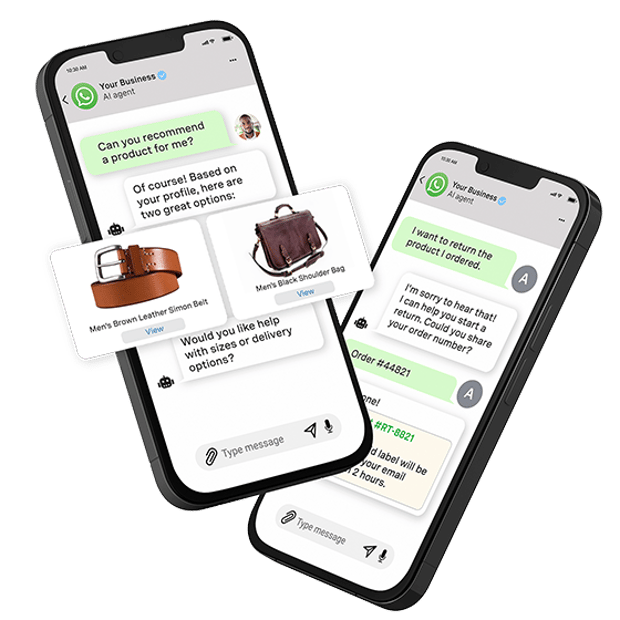

For businesses, the important question is not simply what the technology does — it’s what happens when a customer conversation can become a sales, service, or commerce journey — without leaving WhatsApp.
One thing is worth understanding from the start: When Meta Business Agent is enabled on a WhatsApp number, Meta’s agent sits in front of the conversation.
For years, businesses have owned every reply on their WhatsApp number, built through their own bots, agents, or support teams.
Meta Business Agent changes that model. The AI responds first. That’s a meaningful operational shift, and it’s worth preparing before launch.
The big picture
The evolution of business messaging has followed a clear arc: One-way notifications gave way to two-way conversations, which gave way to commerce-capable messaging threads.
Now, Meta’s building the next layer — AI agents that can operate within those threads, on behalf of the business, at scale.
The context makes this shift significant:
- More than 1 billion active messaging threads between people and businesses occur daily across Meta platforms.
- More than 1 million businesses were already using a Meta Business Agent on WhatsApp and Messenger before the platform reached general availability.
- 62% of consumers say they would turn to a generative AI chat experience before other channels to get information.
- 68% of online adults believe AI agents help them get more done in a chat.
- Consumer use of AI customer service agents grew 22 times between January and September 2025.
WhatsApp is uniquely positioned for this shift. It's already where billions of customers interact with businesses. The channel is conversational by nature, known for high frequency, and deeply trusted. It doesn’t require downloading a new app or creating a new account. Meta Business Agent layers intelligence directly onto that foundation.
What is Meta Business Agent?
Meta Business Agent is an AI-powered agent platform that allows businesses to deploy configurable AI agents natively on WhatsApp. These agents can answer questions, make product recommendations, book appointments, qualify leads, and close sales, 24 hours a day.
It’s not a chatbot in the traditional sense. It’s also not a generic AI assistant. And it’s not a human agent replacement in isolation. Instead, it acts as a programmable AI layer, built into the WhatsApp Business Platform, that businesses configure with their own knowledge, tone, business rules, and system connections.
Meta announced the product at the Conversations 2026 conference in London on June 3, 2026. The platform went live for partners on July 1, 2026. Billing commenced on Aug. 1, 2026.
According to Meta’s official developer documentation, businesses can:
- Add knowledge: Include business information, FAQs, websites, and files, so the agent answers from the business’s own content.
- Define how it responds: Set the agent’s tone, priorities, and brand voice.
- Connect business systems: Link APIs and webhooks so the agent can take actions, such as booking appointments or confirming payments.
- Hand off to a human or app: Pass control to the human team or an external application at any point.
The agent operates on phone numbers managed through the WhatsApp Business Platform (Cloud API). Not all businesses are eligible: finance, government, health, alcohol, gambling, over-the-counter drugs, and matrimony services are excluded. The business must meet Meta’s trust and verification requirements and be based in an eligible country.
How it works
The customer journey with Meta Business Agent is deliberately simple from the consumer side. A customer sends a message to a business WhatsApp number. Instead of waiting for a human agent or navigating a rigid scripted chatbot, they receive an immediate, contextual response from the AI agent, which already has access to the business’s product catalog, FAQs, policies, and, via API connections, live business data.
Example journey:
A customer clicks a Facebook ad for a product and is directed to WhatsApp.
The Meta Business Agent responds instantly, answers product questions, and surfaces relevant catalog items.
The customer proceeds to checkout within the conversation.
The agent confirms the order and sends a follow-up.
If the query becomes complex, the business can configure the agent to hand control to a human team with full conversation context preserved.
The platform uses a control model: When the Meta Business Agent holds control of the conversation, any partner application operates in a background “standby” mode and receives a different category of webhooks. When control transfers to a human agent or third-party application, a handover webhook fires, and the human team takes over seamlessly.
This is architecturally different from traditional chatbots, where a human “takes over” by interrupting a rigid flow. Here, the AI and the human team collaborate within a structured control model, and the transition is explicit.
When the agent doesn't know the answer, businesses can configure how it behaves: It can acknowledge the limitation, escalate to a human, or surface the closest available information.
Why WhatsApp matters for AI agents
Meta is not deploying AI agents on a new or experimental platform. It's deploying them where business-to-consumer conversations are already happening at scale.
The practical advantage is significant. AI agents on WhatsApp inherit the channel’s existing trust, install base, and conversational infrastructure. A customer doesn’t have to download a new app, log into a new portal, or change their behavior. They message the business exactly as they would today, but the response is now AI-powered, instantaneous, and available at any hour.
WhatsApp also brings first-party intent signals. When a customer initiates a conversation from a click-to-WhatsApp ad, that interaction carries commercial intent and contextual data that a cold support channel does not. Meta Business Agent can work with that context from the first message.
The combination of reach (3.5 billion users across Meta platforms), conversational context, commerce capability, authentication, and now AI creates something qualitatively different from any other business messaging channel.
What changes for businesses
Customer service
The operational impact is immediate. An AI agent that can handle thousands of inbound conversations simultaneously, in the customer’s language, at any time, changes the economics of first-line support.
Routine queries, like order status, opening hours, product information, and appointment availability, can be resolved without human involvement. Human agents are freed for genuinely complex or sensitive interactions, with full conversation context passed across on handoff.
Response time, historically a key satisfaction driver in customer service, becomes structurally unlimited. An AI agent does not have a queue.
Marketing
The shift here is more fundamental. Meta Business Agent creates a path from broadcast campaign to individual conversation within the same thread. A marketing message goes out. A customer responds with a question. The agent qualifies their interest, surfaces relevant products, and moves them toward a transaction. The campaign doesn’t end when the message is delivered; it continues as a conversation.
This has direct implications for click-to-WhatsApp advertising, which Meta already positions as one of its highest-performing ad formats. With Meta Business Agent, the post-click experience becomes dynamic and intelligent rather than static.
Commerce
Early adopters referenced in Meta’s partner materials point to a commerce use case that goes well beyond product discovery:
- A post-order trigger activates the agent to offer cross-sell recommendations, with product images and comparisons surfaced within the conversation.
- End-to-end booking journeys, including payment confirmation, are handled entirely within a single WhatsApp thread.
- AI-powered lead qualification captures customer intent before passing a high-quality prospect to a sales team.
The direction is clear: ad click → WhatsApp conversation → product discovery → recommendation → transaction, managed by AI, within a channel the customer already trusts.
Operations and workforce
The agent does not replace human teams. It changes what those teams handle.
Contact centers that currently spend most of their capacity on repetitive first-line queries are the most directly affected. The conversation design question — how to structure handoffs, define escalation triggers, and maintain brand consistency across AI and human interactions — becomes a core operational capability.
Two ways to deploy
Meta has introduced two architectural paths.
Approach
Description
Status
1P: Build natively
Meta builds and runs the agent on the WhatsApp Business Platform. Businesses configure knowledge, tone, and business rules.
Available now
3P: Agent-to-agent integration
A business’s existing AI agent (any LLM) integrates with the Meta platform, enhanced with first-party customization and WhatsApp-native rich media.
Coming soon
This dual-path approach is significant for enterprises that have already invested in AI infrastructure. They will not be required to rebuild. They will be able to connect their existing agent to WhatsApp via Meta's Platform and take advantage of native capabilities.
Chatbots vs. AI agents: An important distinction
Meta Business Agent represents a materially different architecture from traditional rule-based chatbots.
Traditional Chatbot
Meta Business Agent
Rule-based, predefined flows
Context-aware, dynamic conversations
Customer follows a fixed script
Conversation adapts to the customer’s input
Limited integration with live systems
Answers from a configured knowledge base
Minimal context across the conversation
Maintains conversational context throughout
A key point: Meta Business Agent is not a fully autonomous AI agent in the academic sense. Businesses configure and control what it knows, how it responds, and when it hands off. The intelligence is real; the boundaries are set by the business. This is by design, and brand consistency, regulatory compliance, and customer trust all depend on it.
How it is priced
Meta Business Agent uses a token-based pricing model, a structural departure from the per-message model used for other WhatsApp message types.
- Meta charges $2 per 1 million tokens for Meta Business Agent messages.
- A typical message exchange consumes approximately 20,000–25,000 tokens, making the effective cost roughly 4–5 cents per message.
- Actual cost varies with complexity: A simple FAQ response uses fewer tokens than a multi-step product recommendation with catalog browsing.
- Meta bills businesses directly for token consumption via a dedicated credit line in WhatsApp Manager, per phone number, separate from the standard BSP invoice.
- Inbound messages from customers remain free.
- Each message has one category and is charged once — no double billing.
The token-based model reflects an alignment with how AI services are priced more broadly, where cost is proportional to the computational work involved in generating a response. A straightforward greeting costs less than a personalized commerce journey.
The billing mechanics matter as much as the rate. Businesses running their WhatsApp setup through a provider like Vonage will receive two distinct bills: one from their BSP for standard messaging, and one directly from Meta for Meta Business Agent token consumption. That is a forecasting and finance consideration, not just a technology one, and worth factoring into budget planning before deployment.
 Risks and open questions
Let’s take a look at some of the cautions with this new technology.
- Accuracy and hallucination: AI agents can produce incorrect or misleading responses. Businesses must configure the knowledge base carefully, monitor agent performance, and define clear escalation paths for sensitive topics. Meta’s developer documentation includes testing tools; using them isn’t optional.
- Brand safety: An AI agent responding at scale, in the business’s name, represents a reputational risk if poorly configured. The agent’s tone, boundaries, and guardrails need to be actively designed, not assumed.
- Privacy and data governance: Businesses must understand what data the agent accesses, how it’s used, and what their obligations are under applicable privacy regulations. GDPR compliance, particularly for European operations, requires careful review.
- Customer consent and transparency: Customers interacting with an AI agent rather than a human should ideally be aware of that distinction. Transparency matters for trust, and in some jurisdictions may be a legal requirement.
- Integration complexity: Connecting the agent to live business systems — CRM, order management, inventory, and booking platforms — requires engineering work. The promise of an end-to-end in-conversation commerce journey depends on those integrations being reliable and well-governed.
- Handoff control: Human takeover is triggered by Meta’s own signals. The handoff policy is configurable, but the trigger logic itself isn’t. Businesses with hard rules about when a human must take over, for example, in regulated industries or sensitive service contexts, should map this carefully before launch and test it thoroughly before going live.
- Attribution and measurement: How do businesses measure the commercial impact of an AI-handled conversation compared to a human-handled one? KPI frameworks for AI-assisted commerce are still emerging.
- The bypass risk: There’s a structural question for businesses working through BSPs: Can customers or businesses activate Meta Business Agent directly through WhatsApp Business Manager, bypassing their existing partner setup? This is an active consideration that businesses should discuss with their BSP before deployment.
What businesses should do now
The platform is live. The pricing is active. Waiting is a choice that comes at a cost.
Practical steps
Audit existing WhatsApp use cases: Identify the volume and types of conversations currently handled by human agents, chatbots, and automated flows.
Map repetitive, high-volume interactions: These are immediate candidates for AI agent handling, such as FAQs, order status, appointment booking, and product information.
Map the full customer journey: Where does a customer first contact you? Where do they drop off? Where could AI assistance reduce friction?
Review data accuracy: The quality of the AI agent’s responses is only as good as the quality of the knowledge base it draws from. Product data, pricing, policies, and FAQs must be current.
Design human handover: Define the conditions under which the AI hands off to a human, and ensure the handover carries full context.
Review consent, privacy, and compliance: This is especially critical for European operations and regulated industries.
Connect your data: The most valuable Meta Business Agent deployments involve live integrations — CRM, order management, and booking systems. Plan for that engineering work.
Define KPIs: Resolution rate, handoff rate, conversation-to-conversion, customer satisfaction, cost per interaction ... set baselines before you go live.
Start with contained use cases: A 24/7 FAQ agent for a single product line is a lower-risk starting point than an end-to-end commerce journey. Expand from evidence.
Design for AI and human collaboration: Don’t use AI to replace every interaction: The goal is intelligent routing, not wholesale automation.
The Vonage perspective
As a WhatsApp Business Solution Provider and Meta Business Messaging Partner, Vonage supports businesses in deploying and scaling Meta Business Agent on WhatsApp. Businesses already using WhatsApp through the Vonage platform can work with their Account Manager to explore Meta Business Agent for their setup.
Vonage provides the WhatsApp Business Platform infrastructure — account provisioning, Cloud API access, message delivery, and compliance — that Meta Business Agent runs on top of. Beyond the platform layer, Vonage is actively developing deeper integration capabilities to connect Meta Business Agent with the broader enterprise stack: CRM, contact center, marketing automation, and customer data systems. That work is ongoing, and further capabilities will be made available as they are ready.
The future of business messaging on WhatsApp isn’t a single product. It’s an ecosystem: Meta’s platform + WhatsApp infrastructure + AI agents + business systems + APIs + human teams + CPaaS layer. The most effective deployments will bring all of those components together thoughtfully.
For businesses already on the WhatsApp Business Platform, the path to Meta Business Agent is not a rebuild. It’s an evolution. And with Vonage, the foundation is already in place.
Conclusion
Meta Business Agent is not significant simply because it lets businesses automate another support interaction. That framing is too narrow.
The deeper shift is this: WhatsApp is evolving from a communications channel into an intelligent, transactional interface. Meta Business Agent is an interface where a consumer can discover a product, ask questions, get personalized recommendations, complete a purchase, and receive follow-up support — all within a single, ongoing conversation thread, powered by AI, available at any hour.
For enterprises that have spent years building WhatsApp into their customer engagement stack, this is the moment the channel matures into something more. Not a messaging tool, but a business interface.
The question is not whether to engage with that shift. It's how well-prepared your business will be when your customers expect it.
