Secure Messaging API for Customer Communication That Ensures Compliance and Reliability
Vonage Secure Messaging API encrypts sensitive customer communications with verified sender identity and seamless integration into both legacy and modern systems. Deliver trusted messages effortlessly across SMS, WhatsApp, RCS, and more, while maintaining full compliance, control, and brand integrity.
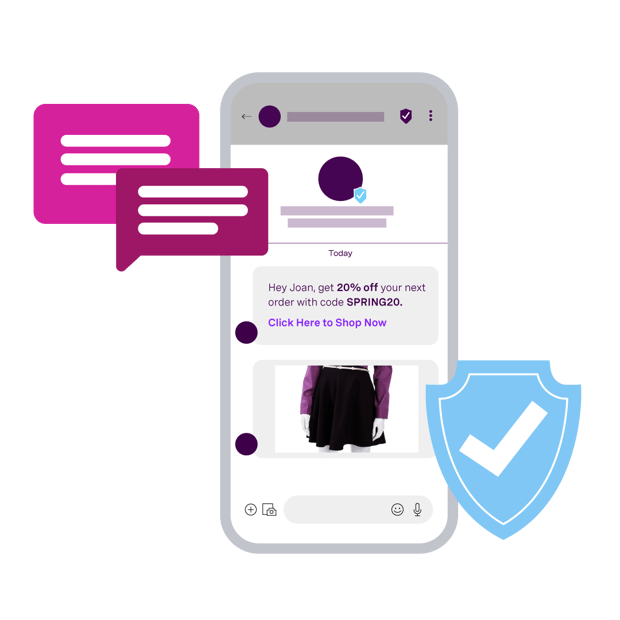
Why secure messaging matters now
Cyber threats, regulatory requirements, and aging infrastructure are putting pressure on your IT department and security leaders to rethink how they manage customer and internal communications.
If your organization still relies on unencrypted email, siloed systems, or unsecured portals, both your data and your reputation could be at risk.
In fact:
Over 60% of cyber incidents in 2023 targeted critical national infrastructure (CNI), with ransomware, espionage, and data breaches growing increasingly sophisticated. (Wire, 2025)
The average cost of a data breach in financial services reached $6.08 million in 2025 — 22% higher than the global average. (IBM via Wire, 2025)
New compliance directives like NIS2 are enforcing stricter cybersecurity requirements across critical industries, with noncompliance carrying severe fines, service disruptions, and reputational damage. (Wire, 2025)
At the same time, customer and partner expectations have evolved. People want fast, convenient updates — but they also expect their personal information to be handled responsibly. Research shows:
80% of customers say the experience a company provides is as important as its products and services. (Salesforce, State of the Connected Customer, 2025)
79% of customers expect consistent, connected interactions across departments, yet more than half say they often feel like they’re dealing with silos. (Salesforce, State of the Connected Customer, 2025)
73% of customers expect better personalization as technology advances, but 61% say most companies still treat them like a number. (Salesforce, State of the Connected Customer, 2025)
79% of customers are increasingly protective of their personal data, and 71% say they’re more likely to trust a company if its data use is clearly explained. (Salesforce, State of the Connected Customer, 2025)
Every message — whether it’s an appointment reminder, a bank notification, or a system alert — needs to be delivered securely, to the right person, through a trusted channel.
This is where secure messaging comes in. By adding encryption, sender verification, and multi-channel delivery options, organizations can protect sensitive communications while keeping the customer experience seamless and trustworthy.
In the following sections, we’ll explore what a secure messaging API is, the features that matter most when evaluating solutions, and how secure communication supports industries from healthcare to financial services to the public sector.
What is a secure messaging API?
A secure messaging API is a software interface that lets you send and receive encrypted messages between systems, applications, and users — while protecting the content from unauthorized access. Unlike basic text messages or unsecured email, secure messaging APIs are built for compliance, identity verification, and large-scale delivery.
With an API-based messaging platform, your teams can embed secure communications directly into your workflows and applications. This is especially useful in industries where message content must meet strict privacy or data security standards.
For example:
In healthcare, a secure messaging API can send HIPAA-compliant appointment reminders, prescription updates, or pre-and post-care instructions — delivered through SMS, WhatsApp, or patient-preferred channels.
In financial services, it can automate fraud alerts, transaction notices, or account balance updates — while ensuring encryption and sender authenticity.
In enterprise IT or public sector, it supports internal alerts, password resets, or secure messages to users — even when systems span legacy and cloud-based infrastructure.
Best-in-class secure messaging APIs provide a foundation for delivering sensitive communications with confidence. Whether the goal is to replace aging email systems, modernize internal communication, or scale customer notifications, it allows organizations to balance security, flexibility, and user experience.
Evaluating secure messaging APIs: Features that matter
Understanding what a secure messaging API is only answers part of the question. The next step for IT leaders, developers, and compliance teams is knowing how to evaluate one.
While many messaging APIs prioritize speed and scale, security and interoperability are often treated as afterthoughts. For organizations managing sensitive data, it’s essential to look for capabilities that go beyond basic delivery — ensuring encryption, verified identity, compliance readiness, and seamless integration with complex system environments.
Let’s look at the core features and evaluation criteria to keep in mind when selecting a secure messaging API for your organization:
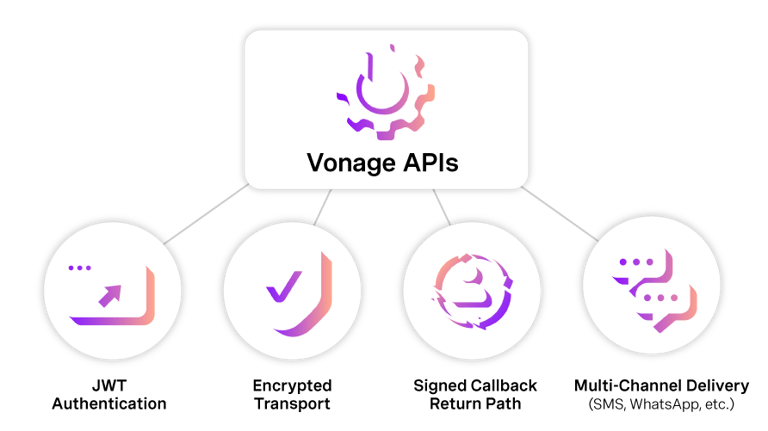
End-to-end encryption and JWT authentication
The API should encrypt messages in transit and support modern authentication standards such as JSON Web Tokens (JWT). This ensures that only authorized systems can send and receive sensitive data, minimizing risks like spoofing or unauthorized access.
For business leaders, this translates to stronger fraud prevention, lower compliance risk, and higher customer trust in digital interactions.
Signed callbacks for message integrity
Look for communications APIs that offer signed delivery receipts or callbacks. These provide verifiable proof that a message was delivered unaltered, supporting audit requirements and preventing tampering.
This capability helps organizations meet regulatory audit standards while ensuring critical communications — like financial alerts or patient updates — are provably trustworthy.
Unified API across channels
A unified API that can route messages via SMS, WhatsApp, RCS, Facebook Messenger, or Viber simplifies development and reduces overhead. Without this, teams often face added complexity managing separate SDKs or vendors per channel.
For communications teams, this means faster rollouts of customer notifications across preferred channels, without duplicating efforts or costs.
Compatibility with legacy and hybrid systems
Organizations rarely operate in greenfield environments. Communications APIs that can integrate with CRMs, EMRs, contact centers, and middleware — without requiring full rebuilds — are better suited for modernization initiatives.
This allows IT and business leaders to modernize communications gradually, avoiding the disruption and cost of replacing critical legacy systems all at once.
Built-in delivery optimization and fallback logic
Messaging systems must be resilient. APIs with features like adaptive routing or channel fallback logic improve reliability across unpredictable delivery networks.
For operations and CX leaders, this ensures customers still receive critical updates–like fraud alerts or appointment reminders — even when one channel fails.
Developer tooling and transparent onboarding
APIs should offer self-service tools, sandbox environments, clear documentation, and SDKs to help developers build and test secure messaging workflows with confidence.
This reduces time-to-market for new services, accelerates compliance validation and gives leadership confidence that systems will work reliably before launch.
These features form the foundation of a secure, compliant, and future-ready messaging strategy. Organizations that prioritize them are better equipped to protect sensitive communications, meet regulatory demands, and maintain user trust — while also enabling scale and interoperability across diverse systems.
Vonage secure messaging API brings these capabilities together in a single platform, offering enterprises a way to integrate secure, multichannel communication without disrupting existing infrastructure.
Use cases for secure messaging APIs
Secure messaging is not just about protecting data — it also enables critical communication within regulated and high-stakes environments.
Data protection and compliance considerations
When implementing secure messaging in regulated environments — such as healthcare or financial services — organizations must navigate a complex landscape of compliance requirements and security frameworks.
The best secure messaging APIs are designed to support data protection standards such as:
HIPAA (Health Insurance Portability and Accountability Act)
GDPR (General Data Protection Regulation)
SOC 2 (System and Organization Controls)
ISO/IEC 27001 (Information Security Management)
Beyond regulatory compliance, modern messaging systems should also enable deployment within zero-trust environments, offering features like:
End-to-end encryption of message content
Role-based access controls
Tamper-evident message verification
Audit logging for traceability and oversight
For organizations integrating messaging into sensitive workflows — such as patient communications, financial alerts, or internal system notifications — these capabilities are not optional. They form the foundation of trustworthy digital communication and reduce exposure to data breaches, operational risk, and reputational damage.
Healthcare
Healthcare providers face strict privacy regulations, like the Health Insurance Portability and Accountability Act (HIPAA), while patient expectations continue to evolve. A recent study showed that 40% of healthcare consumers say security in digital communications is most important — surpassing even clarity and timeliness–highlighting how trust is now central to patient engagement.
In healthcare use cases, HIPAA-compliant messaging APIs support critical workflows such as:
HIPAA-compliant appointment reminders, confirmations, and test results
Medication reminders and post-care instructions
Real-time two-way sessions via RCS or Facebook Messenger
Enhanced patient trust and workflow efficiency, all through encrypted, verifiable messaging
Financial services
Financial organizations must balance customer experience with stringent data security requirements. According to an IBM study, the average cost of a data breach in financial services rose to $6.08 million in 2024, which is about 22% above the global average. With such high stakes, encrypted and authenticated messaging is not only best practice — it is a risk mitigation necessity.
Secure financial communication APIs enable:
Real-time secure notifications for fraud alerts, account changes, or sensitive financial updates
More secure delivery of statements or payment reminders
Two-factor authentication (2FA) to verify user identity
Automated balance, loan, or credit notifications across channels like SMS or WhatsApp
Cross-industry applications
Secure messaging can also drive efficiency and resiliency across other sectors. Legacy infrastructure remains a barrier: 70 % of Fortune 500 firms still rely on software developed 20+ years ago, compounding modernization challenges. A well-built secure messaging API bridges those gaps, integrating seamlessly into both legacy and modern environments.
Other cross-industry use cases include:
Internal alerts and critical IT or operations notifications
Emergency communication with message verification
Secure messaging across departments or contractors
Password resets or account recovery communications with audit tracking
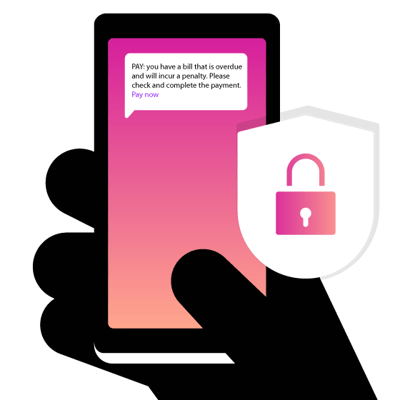 Fight messaging fraud with Vonage Fraud Defender
Integrate with legacy systems and complex stacks
For many IT teams, adding new communication channels is not just a technical challenge — it’s a compatibility issue. Outdated infrastructure, siloed systems, and compliance requirements often make it difficult to perform full platform upgrades. Instead, organizations must modernize workflows gradually, working within strict architectural and regulatory constraints.
Secure messaging APIs that support interoperability are designed to solve this problem. Rather than assuming a greenfield environment, they can integrate with both legacy and modern stacks — whether systems are on-premises, cloud-based, or hybrid. This flexibility allows teams to modernize without disrupting critical operations.
Key integration capabilities to look for include:
Support for CRM systems, EMRs, contact centers, and other legacy data platforms
Compatibility with RESTful web services and existing API gateways
Secure deployment models aligned with enterprise access control and data handling policies
Flexible authentication and webhook support for routing messages between backend systems and secure front-end channels
This level of interoperability is especially valuable in industries with deeply embedded infrastructure — such as healthcare, financial services, and the public sector — where rebuilding from scratch is not a realistic option.
Vonage messaging API brings these integration features together, enabling IT teams to add secure, programmable messaging to their existing environments while meeting compliance goals and maintaining uptime.
Build trust with branded, authenticated communication
In industries where data protection is critical — such as healthcare or financial services — trust isn’t just about what the message says. It’s about verifying the sender, protecting message integrity, and ensuring delivery through secure, recognized channels.
To support this level of assurance and Own Your Brand, secure messaging APIs should offer:
Authentication at the API level
Using methods like JWT authentication, only authorized systems should be able to initiate message delivery. This minimizes the risk of spoofed communications or unauthorized access.
Verifiable message integrity
APIs that support signed callbacks enable receiving systems to confirm that a message originated from a trusted source and was not modified in transit. This is essential for compliance with audit trails and regulatory standards.
Branded messaging across secure channels
Secure messaging platforms that support verified sender IDs (e.g., WhatsApp Business or RCS verified sender) help recipients recognize and trust incoming messages. This is especially important in situations like fraud alerts, medical reminders, or financial notifications — where trust directly affects engagement and response rates.
Reduced risk of impersonation and fraud
By delivering encrypted, branded, and authenticated messages, organizations can help reduce phishing risk and prevent messages from being flagged as spam or dismissed as illegitimate.
These features work together to build a secure communication layer that users can trust — even in sensitive or high-risk environments.
Automate messaging with APIs and rich media
Manual outreach is rarely sustainable — especially in industries where timing, accuracy, and reliability are critical. Secure messaging APIs allow IT and operations teams to automate sensitive communications while also improving engagement through rich business messaging. Using a single programmable interface, organizations can design workflows that are fast, verifiable, and context-rich.
Examples of automation use cases include:
High-value notifications: Transactional alerts, appointment reminders, or service updates can be triggered in real time or scheduled in advance, reducing manual effort and delivery delays.
Two-way communication: APIs enable conversations across SMS, WhatsApp, RCS, and other channels, allowing users to confirm appointments, respond to alerts, or request assistance — while maintaining data privacy.
Rich media experiences: Communications APIs can support images, videos, QR codes, interactive buttons, and even location sharing to make secure messages more actionable. A bank might enable a “Dispute this charge” button in a transaction alert, or a hospital could send a check-in barcode via RCS.
Fallback logic for reliability: Resilient workflows can automatically reroute undelivered messages through alternate channels (e.g., from WhatsApp to SMS) to ensure recipients still get critical updates.
When implemented effectively, automated secure messaging moves beyond basic scheduling to become a core part of an organization’s communication infrastructure — built for scale, resilience, and user trust.
Vonage API combines automation, rich media, and multichannel fallback into a single programmable platform.
Developer tools and integration support
For secure messaging to work at scale, APIs must do more than provide encryption and compliance features. They also need to integrate seamlessly into existing environments, support developer workflows, and scale reliably from sandbox testing to full production deployment.
Key capabilities that support developer and IT teams include:
Fast setup with self-service tools: Sandboxes, tutorials, and reference guides allow teams to start testing quickly without impacting production systems.
Transparent monitoring and logs: Channel-specific insights, delivery receipts, and error simulations help validate secure message routing and troubleshoot issues before launch.
Unified API across all channels: A single, abstracted API that supports SMS, WhatsApp, RCS, MMS, and other channels reduces integration complexity and avoids duplicate builds.
Flexible architecture: REST APIs, webhook callbacks, and middleware compatibility ensure integration with both modern cloud-native systems and legacy infrastructure.
Scale and reliability: Enterprise-grade uptime SLAs, global reach, and built-in failover logic give IT teams confidence that secure communication flows will remain dependable.
When evaluating secure messaging APIs, organizations should consider how developer tooling and integration flexibility align with their existing workflows.
Vonage Messages API combines these capabilities — offering sandboxes, SDKs, unified channel support, and reliability features designed to help developers build secure, scalable communication systems with speed and confidence.
A quick look at the highlights of secure messaging APIs
What is a secure messaging API?
A secure messaging API — also known as an encrypted messaging API — is a programmable interface that enables encrypted and authenticated communication between systems, applications, and users. It’s designed to protect sensitive message content during transmission and ensure that messages are sent by verified sources.
How does a secure messaging API work?
Secure messaging APIs typically use encryption protocols (such as TLS or end-to-end encryption), authentication methods like JSON Web Tokens (JWT), and delivery verification mechanisms to ensure data integrity. They often support multiple messaging channels including SMS, WhatsApp, and RCS.
What features should I look for in a secure messaging API?
Key features include:
Encryption in transit and at rest
Sender and receiver authentication (e.g., via JWT or OAuth)
Signed callbacks or delivery receipts
Support for multiple communication channels
Compliance with standards like HIPAA, GDPR, or SOC 2
Compatibility with existing systems (e.g., CRMs, legacy apps)
Ability to secure access to inbound media, using a JWT to access the media URL
Is a secure messaging API necessary if we already use email or SMS?
Yes, especially if you are handling sensitive or regulated data. Standard email and SMS often lack encryption, authentication, or message integrity checks — making them vulnerable to spoofing or data exposure. A secure messaging API adds essential protections and verification layers.
Can secure messaging APIs integrate with legacy infrastructure?
Many secure messaging APIs are designed to work alongside existing infrastructure, including on-premises systems, CRMs, or sector-specific platforms like EMRs or financial applications. Integration typically happens through RESTful APIs, webhooks, or middleware.
Are secure messaging APIs compliant with industry regulations?
Leading APIs support compliance with industry-specific and global data protection standards such as HIPAA, GDPR, SOC 2, and ISO 27001. However, compliance also depends on how the API is implemented within your broader system architecture.
Getting started with secure messaging APIs
Modernizing communications with a secure messaging API doesn’t require a complete system rebuild. Many platforms support phased implementation, starting with sandbox testing and scaling into production once systems are validated.
If you're exploring secure messaging solutions, consider the following steps:
Test in a sandbox environment
Most APIs offer developer sandboxes where you can simulate message workflows, delivery behavior, and security features like signed callbacks — all without deploying live code.
Review technical documentation
Look for platforms that provide thorough, channel-specific API docs, Postman collections, onboarding guides, and sample code to speed up integration.
Validate delivery and compliance workflows
Before going live, ensure the solution supports your operational and regulatory needs — including encryption, authentication, delivery receipts, and fallback logic.
Plan your integration path
Consider your architecture (legacy, hybrid, or cloud-native) and evaluate how the API fits into your existing systems. If needed, consult vendor integration specialists for support with message routing or compliance implementation.
Ready to experiment with secure messaging? Set up a free Vonage developer account to access sandbox testing, API documentation, and integration resources.
Secure messaging built for the demands of modern infrastructure
Secure communication is a requirement for any organization that handles sensitive or regulated data. Whether you are supporting patients, customers, or internal teams, the messages you send must be encrypted, authenticated, and reliably delivered — without adding complexity to your tech stack.
Vonage secure messaging API is designed for that reality. It integrates with legacy systems and modern platforms alike, provides message-level verification through JWT and signed callbacks, and supports global messaging across SMS, RCS, WhatsApp, and more — all from a single API.
With security and compliance built in, and automation and scale fully supported, Vonage gives IT and security teams the tools to modernize communications while maintaining control.
If your messaging system needs to do more — deliver faster, prove sender authenticity, or support new workflows — Vonage provides the infrastructure to get you there.
Sign up now
Was this helpful? Let's continue your API journey
Don't miss our quarterly newsletter to see how Vonage Communications APIs can help you deliver exceptional customer engagement and experiences on their favorite channels.

Thanks for signing up!
Be on the lookout for our next quarterly newsletter, chock full of information that can help you transform your business.
Still have questions about secure messaging APIs
Cyberattacks targeting critical infrastructure are on the rise, and new compliance frameworks like NIS2, HIPAA, and GDPR are raising security expectations. Secure messaging APIs help organizations reduce exposure, protect customer data, and avoid regulatory penalties.
By encrypting content, verifying sender identity, and delivering through trusted channels like WhatsApp, SMS, or RCS, secure messaging APIs show customers that their privacy and safety are a priority — strengthening engagement and brand loyalty.
A standard messaging API focuses on speed and scale, but often lacks encryption, compliance features, or sender authentication. A secure messaging API adds encryption, signed callbacks, compliance support, and brand verification to protect sensitive data.
Yes. With direct carrier connections in 190+ countries, 99.99% uptime, and built-in fallback routing, Vonage Messages API is designed to handle enterprise-scale communications reliably across regions.
Yes, secure messaging APIs can deliver images, videos, QR codes, interactive buttons, and location data while ensuring encryption and compliance. This makes critical communications both actionable and secure.
Vonage provides self-service sandboxes, SDKs, Postman collections, and transparent documentation, enabling developers to test and deploy secure messaging workflows quickly — without slowing down compliance reviews or production launches.