WhatsApp Business Messaging for Retail Customer Service
WhatsApp Business Messaging is transforming how retail brands deliver customer service by making it faster, more personal, and seamlessly interactive. From automated order tracking to real-time support and post-purchase care, retailers are using WhatsApp to handle high volumes of customer interactions while preserving the warmth and trust of human conversations.
With features like chatbots, quick replies, rich media, and opt-in flows, businesses can resolve issues, send updates, and even process returns, all within a familiar chat experience. The result? Lower support costs, higher satisfaction, and customer loyalty that scales.

-
1.
-
2.
-
3.
-
4.
-
5.
-
6.
-
7.
-
8.
-
9.
What is WhatsApp Business Messaging?
WhatsApp Business Messaging refers to the set of tools and APIs (application programming interfaces) that allow companies to communicate with customers on WhatsApp, one of the world’s most widely used chat platforms. Unlike standard messaging, the business version adds structured templates, automation, and verified business profiles so that conversations can be professional, scalable, and secure.
Businesses can send order updates, resolve support questions, and even offer post-purchase care in the same app customers use to talk to family and friends. Because WhatsApp messages are end-to-end encrypted and feature-rich (including buttons, media, and structured templates), they offer a far more interactive customer service experience than SMS or email.
There are two primary products under WhatsApp Business Messaging:
WhatsApp Business App, built for small businesses to manage chats manually
WhatsApp Business API, designed for larger organizations needing automation, CRM integration, and multi-agent support
For the purposes of this article, we’ll focus on the WhatsApp Business API — the enterprise-grade platform best suited for retail brands looking to deliver automated, scalable customer service.
How retail brands use WhatsApp for customer service
Retailers use WhatsApp Business Messaging to power high-touch, real-time support across the customer lifecycle, from product discovery to post-purchase care.
Here’s how interactive customer service plays out in practice:
Order tracking via WhatsApp: After checkout, customers receive a WhatsApp message with delivery status and a button to get real-time tracking updates, no login or app-switching required.
FAQ automation: Common questions like “Where is my order?,” “What’s your return policy?,” or “How do I cancel?” are answered instantly using pre-approved WhatsApp templates or intelligent chatbots.
Post-purchase care: Brands use two-way messaging for handling exchanges, reviews, and delivery issues. Customers appreciate the speed and personalization, and agents save hours with automation.
Promotions and opt-in marketing: Once a customer has opted in, WhatsApp becomes a powerful channel for sending personalized offers, restock alerts, and loyalty incentives, all with interactive buttons that drive action.
With opt-in consent and rich messaging features, WhatsApp has become more than a chat app; it’s now a service channel, feedback tool, and post-purchase concierge rolled into one.
Why WhatsApp Business Messaging matters in 2026
WhatsApp Business Messaging has become a must-have for retail brands aiming to deliver frictionless, interactive customer service. With over three billion global users and rising demand for messaging-based support, WhatsApp offers a direct, private, and responsive channel, one that far outpaces traditional email or web chat in open rates, satisfaction, and convenience.
In 2026, customer expectations have shifted toward real-time, button-based service. Customers want instant answers, not contact forms. And they expect updates, returns, and rebookings to happen in the same thread where they first reached out. That’s where WhatsApp excels.
Meanwhile, businesses face rising service volumes, increasing privacy regulations, and operational pressure to reduce agent workload. WhatsApp business messaging delivers on all fronts by automating routine tasks, enabling self-service, and improving resolution speed, all within a secure, opt-in environment.
Here’s why WhatsApp messaging is a strategic advantage for retail in 2026:
Key stats and trends
Insight
Source
WhatsApp messages have a 98% open rate, significantly higher than email.
MobileSquared, 2025
Customers are 7x more likely to respond to messages on WhatsApp than email.
Meta for Developers, 2025
Over 70% of consumers expect to message businesses more in 2025 than in 2023.
Statista, 2025
FAQ automation and templates resolve support issues up to 3x faster.
Meta for Business, 2025
Pro Tip: Don’t treat WhatsApp like another notification tool. Use rich features, like buttons, carousels, and quick replies, to turn it into a self-service engine for order support and post-purchase care. Customers love speed and simplicity.
How WhatsApp Business Messaging works
To deliver interactive customer service at scale, retail brands use the WhatsApp Business API, often through a messaging partner like Vonage, to connect their systems, workflows, and agents to WhatsApp in a secure and programmable way.
Here’s how the full customer journey is powered by WhatsApp Business Messaging, step-by-step:
Step 1: Get customer opt-in
Before messaging, you must receive explicit opt-in from customers. This can be collected via checkout pages, SMS, email, or in-app prompts. WhatsApp enforces this as part of its privacy-first policy.
Tip: Use language like “Get order updates and support via WhatsApp” to drive opt-ins.
Step 2: Use pre-approved templates to initiate chats
Brands use template messages (pre-approved by WhatsApp) to reach customers with:
Order confirmations
Shipping updates
Appointment reminders
Product restocks
Post-purchase surveys
Templates can include buttons, links, and rich media
Step 3: Enable two-way messaging
Once a customer replies, a 24-hour session window opens. During this time, agents or chatbots can send interactive messages freely, perfect for handling:
Delivery issues
Returns or exchanges
Product questions
FAQs
Vonage helps businesses route these messages to live agents or bots using intelligent logic.
Step 4: Automate with chatbots and quick replies
WhatsApp supports structured automation. With chatbots, you can:
Offer instant order tracking with just a button tap
Handle frequently asked questions 24/7
Walk customers through product selection, returns, or account updates
This reduces load on human agents and boosts resolution speed.
Step 5: Integrate with CRM and customer data
Through platforms like Vonage, WhatsApp messaging can connect to your CRM or order management system, enabling:
Personalized responses based on customer history
Context-aware automation
Faster case resolution with full data visibility
Track messaging performance using built-in analytics and APIs.
Monitoring of message delivery and read rates
Chat resolution time
CSAT and feedback trends
Bot deflection rates
Use these insights to refine your messaging flows, optimize templates, and improve customer satisfaction.
WhatsApp Business Messaging features and benefits
WhatsApp Business Messaging helps retailers deliver personalized, real-time support across one of the world’s most popular communication platforms. It provides two main solutions designed for different business sizes and needs.
1. WhatsApp Business App (for small to midsize teams)
Create a verified business profile with hours, contact info, and location details
Organize customer conversations with labels such as “new order” or “follow-up needed”
Use quick replies and templates to answer common questions instantly
Set automated greetings or away messages when staff are offline
Display product catalogs directly in WhatsApp for instant browsing and inquiries
2. WhatsApp Business API (for enterprises and scale)
Send automated notifications for orders, appointments, and shipping updates
Support live, two-way conversations between customers and agents
Connect WhatsApp to CRM systems to sync cases, profiles, and service data
Share rich media such as images, documents, and videos for faster problem-solving
Manage multiple agents and concurrent chats securely and efficiently
Pricing summary
The WhatsApp Business App is free for small businesses.
The WhatsApp Business API uses a per-conversation pricing model, with costs varying by region and whether the message is customer- or business-initiated.
Key advantages for retail brands
Direct, trusted communication with customers on a familiar platform
Higher open and engagement rates compared to email or SMS
Global reach, with users across more than 180 countries
Secure interactions through end-to-end encryption and strict opt-in rules
Practical use cases
Customer service for real-time issue resolution
Order and delivery tracking with instant notifications
Targeted marketing messages for special offers or restocks
Feedback collection through quick replies and interactive forms
Best practices for retail success
Always secure customer opt-in before messaging
Respond quickly and maintain a conversational tone
Use automation to scale responses while keeping them relevant
Protect privacy by minimizing sensitive data sharing
When fully integrated with contact center or CRM systems, WhatsApp Business Messaging becomes more than a chat tool. It acts as a real-time engagement platform that automates service, builds trust, and supports personalized customer journeys from discovery to repeat purchase.
What retailers often miss
Many retailers implement WhatsApp Business Messaging but overlook some of its most valuable capabilities.
Interactive elements: Buttons, carousels, and guided flows turn one-way notifications into two-way conversations that improve response rates.
Deeper integrations: APIs can link WhatsApp directly to backend systems such as inventory, shipping, and personalization engines for seamless updates and targeted messages.
Blended service models: The best experiences mix human support with automation, using escalation logic to route complex questions to live agents.
Rich media handoffs: Sharing order summaries, invoices, or how-to videos inside the chat boosts clarity and reduces repeat contacts.
Retail success on WhatsApp depends on using these interactive and integrated tools to create faster, more engaging, and more human customer experiences at scale.
WhatsApp Business Messaging features and benefits
WhatsApp Business Messaging helps retailers deliver personalized, real-time support across one of the world’s most popular communication platforms. It provides two main solutions designed for different business sizes and needs.
1. WhatsApp Business App (for small to midsize teams)
Create a verified business profile with hours, contact info, and location details.
Organize customer conversations with labels such as “new order” or “follow-up needed.”
Use quick replies and templates to answer common questions instantly.
Set automated greetings or away messages when staff are offline.
Display product catalogs directly in WhatsApp for instant browsing and inquiries.
2. WhatsApp Business API (for enterprises and scale)
Send automated notifications for orders, appointments, and shipping updates.
Support live, two-way conversations between customers and agents.
Connect WhatsApp to CRM systems to sync cases, profiles, and service data.
Share rich media such as images, documents, and videos for faster problem-solving.
Manage multiple agents and concurrent chats securely and efficiently.
Pricing summary
The WhatsApp Business App is free for small businesses.
The WhatsApp Business API uses a per-conversation pricing model, with costs varying by region and whether the message is customer- or business-initiated.
Key advantages for retail brands
Direct, trusted communication with customers on a familiar platform.
Higher open and engagement rates compared to email or SMS.
Global reach, with users across more than 180 countries.
Secure interactions through end-to-end encryption and strict opt-in rules.
Practical use cases
Customer service for real-time issue resolution.
Order and delivery tracking with instant notifications.
Targeted marketing messages for special offers or restocks.
Feedback collection through quick replies and interactive forms.
Best practices for retail success
Always secure customer opt-in before messaging.
Respond quickly and maintain a conversational tone.
Use automation to scale responses while keeping them relevant.
Protect privacy by minimizing sensitive data sharing.
When fully integrated with contact center or CRM systems, WhatsApp Business Messaging becomes more than a chat tool. It acts as a real-time engagement platform that automates service, builds trust, and supports personalized customer journeys from discovery to repeat purchase.
What retailers often miss
Many retailers implement WhatsApp Business Messaging but overlook some of its most valuable capabilities.
Interactive elements: Buttons, carousels, and guided flows turn one-way notifications into two-way conversations that improve response rates.
Deeper integrations: APIs can link WhatsApp directly to backend systems such as inventory, shipping, and personalization engines for seamless updates and targeted messages.
Blended service models: The best experiences mix human support with automation, using escalation logic to route complex questions to live agents.
Rich media handoffs: Sharing order summaries, invoices, or how-to videos inside the chat boosts clarity and reduces repeat contacts.
Retail success on WhatsApp depends on using these interactive and integrated tools to create faster, more engaging, and more human customer experiences at scale.
 Customer Engagement
Overcoming WhatsApp Business Messaging challenges
While WhatsApp Business Messaging offers powerful tools for interactive customer service, retail and ecommerce leaders often face barriers during implementation. From consent complexity to data management, overcoming these challenges is essential to delivering a seamless, scalable experience.
Customer opt-in and consent requirements
The challenge:
WhatsApp enforces strict customer opt-in policies to protect user privacy. Businesses must obtain explicit permission before initiating conversations, especially for marketing or proactive service updates.
The solution:
Embed opt-in collection into high-engagement touchpoints, like checkout flows, order confirmations, or loyalty program sign-ups. Use clear language explaining what types of messages customers will receive and when. Vonage APIs make it easier to manage opt-in data across CRM and messaging platforms, ensuring you stay compliant while maximizing reach.
Balancing personalization with privacy
The challenge:
Customers expect tailored support but are wary of sharing personal data over messaging platforms. Missteps here can erode trust quickly.
The solution:
Use secure messaging protocols like WhatsApp’s end-to-end encryption. Only personalize messages using verified, first-party data, such as past orders, loyalty tier, or service history. Vonage supports encrypted, policy-aligned workflows that help teams personalize responsibly, even when using AI bots or templates.
Onboarding customers to interactive messaging
The challenge:
Even loyal customers may be unfamiliar with WhatsApp’s interactive elements, buttons, quick replies, or chatbot workflows. Without proper guidance, usage and engagement can stall.
The solution:
Guide customers through the experience with onboarding messages or button-based FAQs like “Track an Order,” “Speak to an Agent,” or “Return an Item.” Retailers using Vonage’s WhatsApp Business API can deploy pre-built templates that ease onboarding while driving adoption of self-service options.
Managing complexity at scale
The challenge:
Scaling WhatsApp interactions across markets, teams, and systems can create operational strain, especially when juggling chatbots, CRMs, and compliance.
The solution:
Use a centralized messaging API solution that supports routing, reporting, automation, and opt-in management across global teams. The Vonage solution abstracts much of the backend complexity, letting retail brands scale messaging without spinning up new infrastructure or fragmenting the customer journey.
Hypothetical examples of WhatsApp Business Messaging in action
Example 1: Streamlining order tracking for fashion retail
Scenario:
A global fashion retailer struggles with delayed updates and overwhelmed customer service agents during peak sales seasons.
Solution:
Using WhatsApp Business Messaging, they implement interactive order tracking templates. Customers can now receive automated shipping confirmations, delay alerts, and delivery status updates, all in the same WhatsApp thread where they placed the order.
Possible impact:
Significant drop in "Where’s my order?" inquiries
An increase in customer satisfaction (CSAT)
Higher engagement with promotional offers sent post-delivery
Example 2: Reducing return friction for electronics ecommerce
Scenario:
A direct-to-consumer electronics brand faces mounting returns and high abandonment in their online returns process.
Solution:
They integrate a WhatsApp chatbot with button-based flows to guide customers through eligibility checks, return initiation, and label downloads, all inside the chat.
Possible impact:
Faster average return processing time
A drop in return-related support tickets
An increase in repeat purchases within 60 days
Example 3: Boosting support efficiency in beauty retail
Scenario:
An online beauty marketplace with a growing product catalog is struggling to keep up with repetitive pre- and post-purchase inquiries.
Solution:
They deploy FAQ automation on WhatsApp using pre-approved templates and rich messaging (e.g., product images, links, and quick-reply buttons).
Possible impact:
Large percentage of common questions deflected from live agents
Average first-response time significantly reduced
Positive sentiment increased in customer feedback surveys
Vonage WhatsApp Business API: A flexible platform for interactive support
For retailers looking to deliver fast, secure, and highly interactive customer service, Vonage WhatsApp Business API offers a robust solution. It combines scale, reliability, and ease of integration, so you can focus on improving support, not managing backend systems.
Built for modern customer care
With Vonage, you can deploy WhatsApp messaging for retail use cases like:
Order tracking via WhatsApp templates
Instant answers through chatbots and interactive buttons
Post-purchase support and feedback collection
Customer authentication and notifications with end-to-end encryption
Whether you're sending booking confirmations or automating FAQs, Vonage APIs enable real-time engagement across the full customer journey.
Key capabilities for retail and ecommerce
AI-driven chatbots: Build self-service flows to guide customers through returns, product questions, or shipping updates.
Messaging automation: Use programmable messaging tools to handle two-way conversations at scale, without sacrificing quality.
Secure messaging: Protect sensitive interactions with verified numbers, encrypted conversations, and multi-factor authentication.
Rich messaging integration: Combine WhatsApp with your CRM or order systems to personalize every interaction.
Failover to SMS: Ensure message delivery even when customers switch devices or channels.
Designed for developers and business teams
Vonage offers a low-code AI Studio, testing tools via Messages API Sandbox, and flexible Reports API for analytics and optimization. This makes it easier to launch, monitor, and evolve your messaging workflows, without technical bottlenecks.
Support that scales with your business
Vonage powers retail support across the globe, handling high message volumes while meeting regulatory standards like GDPR and CCPA. With Vonage, you can start small and scale fast, with the infrastructure to support everything from local boutiques to enterprise retail operations.
Explore interactive messaging with Vonage WhatsApp Business API.
Why WhatsApp Business Messaging is essential for modern retail support
Interactive retail support isn’t a nice-to-have anymore, it’s a competitive necessity. Today’s customers expect real-time answers, instant order updates, and personalized care, all within the messaging apps they already use and trust.
WhatsApp Business Messaging delivers on those expectations, with features like chatbots, automated FAQs, and interactive order tracking that empower teams to resolve more cases with fewer resources. Retailers can respond at scale without losing the personal touch.
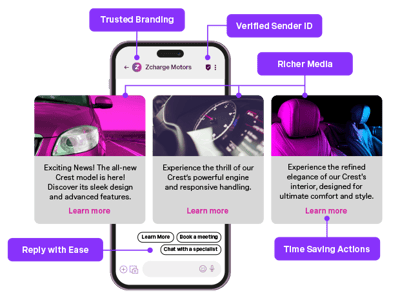
And as retail messaging strategies evolve, RCS (Rich Communication Services) is emerging as another powerful channel for mobile phone users, offering branded, secure, app-like experiences directly in the native messaging app. Combined with WhatsApp, RCS helps retailers reach even more customers with rich, interactive conversations.
With the right API-backed platform, these channels integrate seamlessly into your customer experience stack. From seamless onboarding and privacy compliance to post-purchase engagement, modern messaging is no longer about sending, it's about supporting, selling, and scaling smarter.
Sign up now
Was this helpful? Let's continue your API journey
Don't miss our quarterly newsletter to see how Vonage Communications APIs can help you deliver exceptional customer engagement and experiences on their favorite channels.

Thanks for signing up!
Be on the lookout for our next quarterly newsletter, chock full of information that can help you transform your business.
Frequently asked questions about WhatsApp Business Messaging
WhatsApp Business Messaging is used to deliver customer service, order tracking, and personalized support through the WhatsApp platform. It allows businesses to send automated messages, use chatbots, and provide interactive care directly in the messaging app customers already trust.
Yes. WhatsApp messages are end-to-end encrypted, making it a secure platform for communicating sensitive account or order details. Businesses using the API can also layer in user verification, authentication, and compliance controls.
Absolutely. You can use templates, buttons, and AI-powered chatbots to automate FAQs, order updates, appointment confirmations, and more, all within WhatsApp’s business messaging framework.
Businesses must get explicit opt-in before sending messages. This can be done through websites, checkout pages, or SMS campaigns. WhatsApp’s consent policy ensures customers are in control of the experience.
Not entirely. It complements those channels by offering richer, more conversational experiences. For urgent updates, support interactions, or follow-ups, WhatsApp often outperforms email and SMS in open rates and customer satisfaction.
Yes. With APIs like Vonage Messages API, WhatsApp can be integrated into CRM platforms,enabling unified records, streamlined workflows, and context-aware support across touchpoints.
Yes. With the WhatsApp Business API and platforms like Vonage, retailers can support thousands of concurrent conversations, assign chats to agents, automate responses, and route high-priority issues intelligently.