Your Next Ad Should Start a Conversation
When a customer clicks on an ad, you can open a branded RCS conversation instantly in the messaging app they already use. That’s the power of P2A.


Key Takeaways
- P2A messaging converts intent into conversation — eliminating the leaky funnel.
- The data backing P2A is striking: RCS drives up to 51% click-through rates vs. 4–7% for SMS.
- With RCS supported on both Android and majority of iOS, the addressable market is effectively every smartphone user.
The average consumer sees between 4,000 and 10,000 ads a day. They click on very few of them. And of those who do click, most abandon the landing page before converting. The funnel is leaking — and marketers know it.
The question is no longer whether to fix it. It's how.
Person-to-Application (P2A) messaging is one of the most compelling answers to emerge in years. And for CX and marketing leaders who haven't yet put it on their roadmap, the window to be an early mover is closing fast.
What is P2A, and why does it matter?
In the world of Rich Communication Services (RCS), messaging flows in two directions. A2P (Application-to-Person) is the familiar outbound model — a brand sends a message to a customer. P2A flips the dynamic: the customer initiates the conversation with the brand, directly from an ad, a QR code, a Google Search result, or any other touchpoint.
The result is a conversation that begins with intent. The customer ram,ised their hand. They chose to engage. That changes everything about what happens next.
Unlike a click to a landing page — where the customer is alone, passive, and one distraction away from leaving — a P2A interaction opens a live, branded, interactive conversation inside the customer's native messaging app. No app download. No form to fill in. No friction.
The numbers don't lie
The engagement data for RCS — the channel that powers P2A — is striking, and it's only getting stronger
RCS campaigns drive 15–30% click-through rates, with exceptional cases reaching 51% — compared to just 4–7% for SMS. That's up to 7× higher engagement.
Business campaigns using RCS messaging have shown an 80% conversion rate.
Consumers are 35× more likely to read an RCS message than an email.
90% of rich media messages are opened within 15 minutes, and customers engage with RCS content for up to 45 seconds.
Brands using RCS rich cards saw 60–70% higher conversion rates compared to MMS.
The cost-per-click for RCS is 14× lower than SMS on equivalent campaign objectives, because fewer messages are needed to reach a target conversion.
P2A conversations are growing at 30.75% annually as AI chatbots mature, and consumers grow comfortable completing transactions inside a thread. These aren't marginal improvements. They represent a structural shift in how customers engage with brands.
From ad click to conversation: The P2A moment
Here's what makes P2A particularly powerful in an advertising context.
When a customer clicks a Google Search ad, a social media post, or scans a QR code on packaging or in-store signage, P2A allows that click to open a branded RCS conversation — instantly, in the messaging app they already use every day. on packaging or in-store signage, P2A allows that click to open a branded RCS conversation — instantly, in the messaging app they already use every day.
That conversation can be:
Guided by AI — answering product questions, surfacing personaliszed recommendations, or completing a booking
Enriched with rich media — carousels, images, video, and action buttons that let the customer browse and buy without leaving the thread
Verified and trusted — the brand's logo, name, and verification badge are visible from the first message, eliminating the fear of fraud that plagues SMS
The customer journey compresses from awareness → click → landing page → form → conversion into something far simpler: awareness → conversation → conversion.
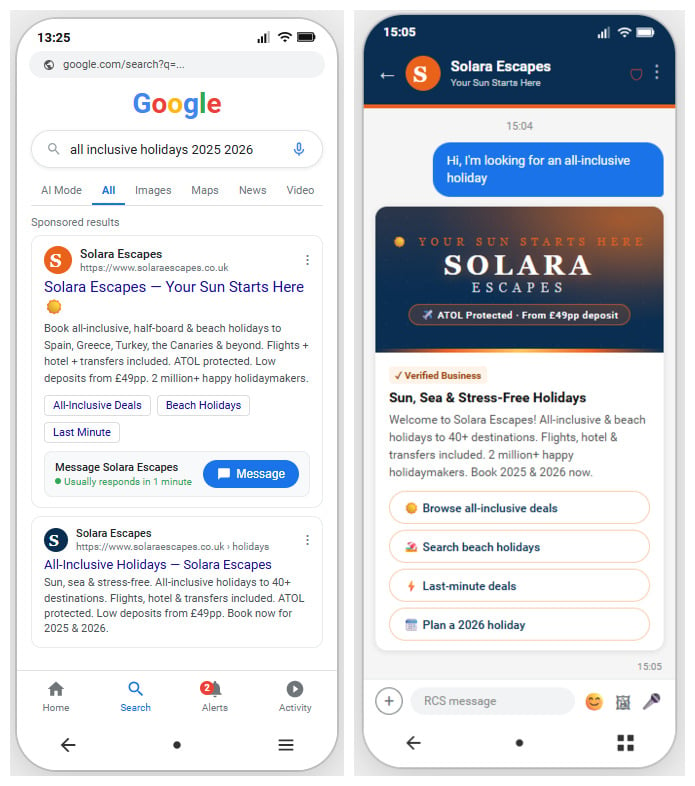
Caption: Example of Ad and RCS message for Solara Escapes
The Vonage and Google partnership: Built for this moment
Vonage, as a strategic partner of Google for RCS Business Messaging (RBM), is uniquely positioned to help brands activate P2A at scale. The Vonage Messages API leverages Google's RBM infrastructure directly, meaning brands benefit from Google's global carrier network, verification framework, and deeplink capabilities — all accessible through a single API integration.
This partnership isn't just technical. Vonage and Google collaborate on joint go-to-market programs, co-hosted events, and shared incentive structures designed to accelerate RCS adoption across key markets including the UK, Germany, France, Spain, and the US. For brands, this means a trusted, enterprise-grade path to P2A — not a pilot, but a production-ready channel.
Google RBM Deeplinks — the technology that enables P2A entry points from ads, QR codes, and web pages — are now live across Vonage's platform, opening the door to richer, interactive conversational use cases far beyond standard outbound messaging.
Who should be paying attention?
If you're a marketing leader running paid search, social, or out-of-home campaigns, P2A is a direct upgrade to your conversion architecture. Instead of paying for clicks that go nowhere, you're paying for conversations that go somewhere.
If you're a CX leader, P2A is the missing link between your acquisition channels and your service experience. The conversation that starts with an ad can seamlessly transition to support, loyalty, or upsell — all within the same thread.
The brands moving first are already seeing the results. The question is whether you'll be among them.
What comes next
P2A is not a distant future. It's available now, across major markets, through platforms like Vonage's Messages API. The infrastructure is ready. The audience is ready — with RCS now supported on both Android and iOS (since Apple's iOS 18 release in most countries), the addressable market is effectively every smartphone user.
What's needed is the strategic decision to make the shift.
Frequently asked questions about P2A messaging
A standard chatbot sits on a website or app - the customer has to find it, load it, and trust it. P2A is different because the conversation is initiated by the customer from a touchpoint they already trust (a Google Search ad, a QR code, a social post), and it opens inside their native messaging app with your brand's verified logo and name visible from the first message. There's no app to download, no page to load, and no anonymous sender. It's a chatbot experience with the reach and trust of SMS — and the richness of an app. Learn more about how RCS messaging works on Vonage.
Getting a test environment live typically takes a matter of days. Going fully live — including brand verification with Google and carrier approval — usually takes 1–2 weeks for most markets outside the US (the US has additional carrier vetting steps that can take longer). Vonage manages the entire agent registration and verification process on your behalf. The Vonage RCS Agent Builder walks through the setup process step by step, and your account manager will guide you through it end to end.
Not at all. P2A is best thought of as an upgrade layer, not a replacement. Your existing SMS opt-in list is also an RCS opt-in list — no re-permissioning required. You can run RCS and SMS in parallel, with Vonage automatically routing to RCS for supported devices and falling back to SMS for others. Many brands start by upgrading a single high-intent touchpoint (such as a paid search ad or a QR code on packaging) and expand from there. For a deeper look at how RCS and SMS compare, see Vonage's RCS vs. SMS guide.
AI is optional but powerful. At its simplest, a P2A agent can be a structured conversation flow with quick-reply buttons — no AI required. At the more advanced end, AI agents can handle open-ended questions, personalisepersonalize responses in real time, and hand off to a live agent when needed. Vonage's platform supports both approaches, and integrates with leading AI and CRM platforms. For a broader view of where P2A and AI are heading together, read From Push to Conversation: The Future of Brand Engagement — a Vonage perspective featuring insights from Google and Salesforce.