The Future of Brand Engagement: Moving From One-Way Alerts to Two-Way Conversations
For three decades, enterprise communications followed the same playbook: build a channel, push a message, wait for action. Toll-free numbers gave way to IVRs. SMS replaced voicemail. Apps promised personalization. Chatbots automated support. AI agents emerged to handle complexity at scale.
Despite the innovation, something went wrong. Engagement didn't consolidate – it fragmented. Consumers now juggle dozens of apps, each demanding attention, storage space, and yet another password. The result? Exhaustion. Not excitement.
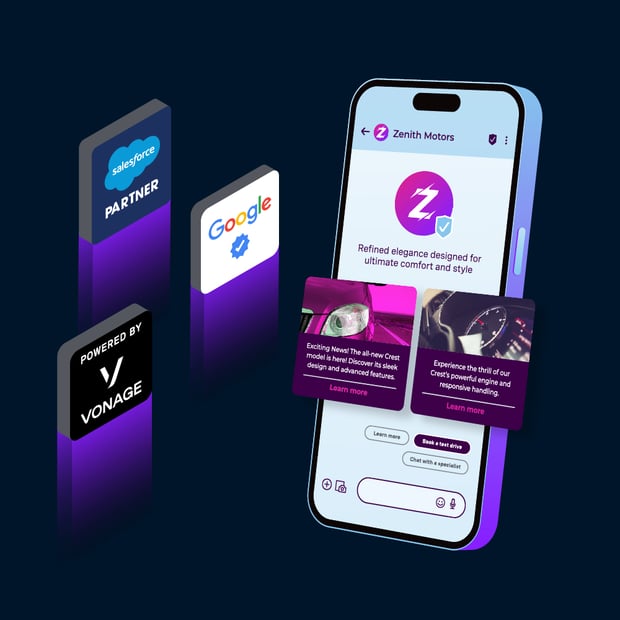

Recently, Vonage hosted a LinkedIn Live event with leaders from Google and Salesforce to explore a fundamental shift happening right now. Communications are moving from Application-to-Person (A2P) messaging, where brands broadcast outward. It’s now about Person-to-Application (P2A) conversations, where consumers initiate contact and AI agents respond intelligently within the thread.
The most powerful digital surface isn't a new app. It's the native messaging inbox already on every phone. This space is evolving from a notification center into something far more strategic: a storefront, service desk, and front door to your enterprise.
Why does this shift matter? What does it mean for revenue and strategy? And how to prepare your team for what’s next? Read on for the answers.
Why ‘more channels’ made things worse
For years, marketers wanted more tools and platforms to reach more customers. After all, they wanted to meet customers at the optimal place and time. The strategy backfired.
That’s because app fatigue is real. The average smartphone user has 80 apps installed but actively uses fewer than 10. Every new branded app adds friction. Every login creates a barrier. Every notification risks being ignored or, worse, triggering an uninstall.
As our Salesforce partner noted during the event, fragmentation is the enemy. The goal was never "more places to talk." Instead, think of "the right place to listen." Increasingly, that place is the native inbox – the same interface consumers use to text friends, family, and colleagues.
This isn't just convenient. It's strategic. The native inbox has near-universal reach, requires no download, and commands genuine attention. Unlike branded apps that get buried in folders, messages appear front and center. Unlike email, they feel personal and immediate.
The inbox already has 100% mindshare. But are you using it strategically?
RCS: The app-less experience businesses need
The native inbox was historically limited to plain-text SMS. Those messages reeked of basic and functional – never to be confused with engaging. That limitation is over.
Rich Communication Services (RCS) brings app-like functionality directly into the messaging thread, with no download required. Carousels, buttons, branded visuals, payments, and verified sender identity all live natively in the inbox. For consumers, it feels seamless. For brands, it's a gamechanger.
As the Google RCS lead explained during our event, three forces converged to make RCS the strategic choice for 2026:
Massive scale. Partnerships between Google and major carriers took years to develop, but we've now reached market scale. All U.S. carriers support RCS across both Google Messages and iMessage, representing 270 million RCS-capable users in the United States alone. The Apple adoption of RCS in markets where iOS commands over 50% share has been transformative.
Consumer behavior shift. Consumers increasingly prefer messaging over traditional channels. They want to interact with businesses the same way they interact with people — through quick, conversational exchanges. RCS meets that expectation by offering persistent threads where either party can again engage after the initial message.
AI maturity. Through tools like Gemini and Vertex AI, brands can now build agentic experiences that feel personal and responsive. These AI-powered interactions need a home that reaches consumers across devices. The native inbox, powered by RCS, is that home.
What makes RCS different
RCS doesn't just deliver messages. It creates experiences. Here's how:
Brand identity. Your name, logo, and colors appear front and center. Customers receive an RCS message and immediately know it’s you. Every business is verified with a tick mark, building trust from the first interaction.
Rich engagement. Carousels let customers swipe through product recommendations. Rich cards combine imagery, copy, and buttons to showcase offers. Videos add storytelling. Suggested actions guide next steps without forcing customers to leave the thread.
Measurable ROI. Every interaction – delivered, read, responded to – is tracked. Marketers can measure engagement on individual products within a carousel, calculate revenue per thread, and optimize in real time.
In-thread commerce. Web views bring the browser experience directly into the conversation. Customers can browse, select, and purchase without switching apps or opening a new tab.
The result? Nespresso saw 3.7x higher purchase intent with RCS compared to SMS. The Los Angeles Rams achieved 50% higher click-through rates across marketing campaigns thanks to branded experiences and interactive visuals.
The demo: Seeing P2A in action
During the event, we walked through a live demonstration using Salesforce Marketing Cloud and a mobile device side-by-side. The goal was to show how a triggered journey looks from the consumer perspective and how that interaction flows back into the unified profile for real-time personalization.
Here's what stood out:
In-thread immediacy. A customer initiates contact by tapping a "Message Us" button from Google Search or Maps. The conversation opens in their native inbox – no app required. An AI agent responds instantly, asking clarifying questions to understand intent. Based on the customer replies, the agent surfaces personalized recommendations in a carousel format. The customer selects a product, views details in a web view, and completes the purchase, all within the thread.
Better targeting. On the backend, every interaction feeds into the customer's unified profile. The brand gains deeper insights into preferences, behavior, and intent. Future messages become more relevant. Fewer campaigns are needed because each one is more targeted.
Proactive conversations. This is the shift from broadcasting to conversing. From guessing what customers want to proactively asking and guiding them with taps.
New skills for a conversational future
This shift requires a new muscle. Marketing Cloud professionals and CX leaders need to evolve beyond static campaigns and subject line optimization. Here are the three core competencies that matter now:
Conversational design
You're no longer writing subject lines. You're designing dialogue flows. That means understanding how to structure conversations, anticipate responses, and guide customers through decision trees without overwhelming them.
Think of it this way: a good conversational experience feels like talking to a knowledgeable store associate, not filling out a form. Every question should move the customer closer to a resolution or purchase.
Data literacy
Triggering messages based on real-time signals like a cart abandonment, service inquiry, or location-based offer requires understanding how to read and act on data streams. Static lists won't cut it anymore.
You need to know how to set up event-driven workflows, segment audiences dynamically, and personalize at the moment of interaction, not hours later.
New metrics
Open rates and click-through rates were built for email. Conversational messaging demands different KPIs: conversation velocity (how quickly interactions resolve), revenue per thread, and engagement depth (how many actions a customer takes within a single conversation).
These metrics reflect the quality of the interaction, not just whether someone opened a message.
Simply start small, then prove ROI
You don't need to overhaul your entire stack overnight. Pick one high-value journey, such as a service reminder, order confirmation, or post-purchase follow-up. Redesign it as a rich, interactive RCS campaign. Run it as a pilot against your existing SMS flow.
Let the results speak for themselves. Once you demonstrate ROI, scaling becomes a no-brainer.
The 12-month outlook: The inbox as super app
Looking 12 to 18 months ahead, the inbox is poised to become something far more powerful than a message delivery system. It's evolving into a super app – the place where identity, commerce, and support converge.
Google is enabling more entry points to help businesses establish initial connections with customers over RCS. You'll see "Message Us" buttons appearing across Search, Maps, and other Google surfaces. Live experiences, like those piloted with IHG and other brands, are just the beginning.
Salesforce predicts that AI agents will make every thread feel like a one-to-one concierge service. Instead of static FAQs or rigid chatbot scripts, customers will engage with intelligent agents that understand context, remember past interactions, and adapt to individual needs in real time.
And it's happening now.
What to do next
The brands that prepare today will own the customer relationship tomorrow. Here’s how to start:
Give modern consumers what they want
What’s a simple way to engage them in the moment? It’s right from their messaging inbox. RCS, combined with AI and tools like Salesforce Marketing Cloud, gives you everything you need to make that shift. This means verified identity, rich engagement, measurable ROI … and most importantly, the ability to have real conversations at scale.
Treat RCS like a new product line
If you're a marketer, CX leader, or strategist, now is the time to embrace RCS. Pick one or two high-value SMS journeys. Redesign them as interactive, consent-first RCS campaigns. Pilot with a verified partner. Measure the results. Then scale.
Watch the replay of our LinkedIn Live event
The full conversation with experts from Google and Salesforce provides insights and best practices. And explore how Vonage can help you build conversational experiences that drive revenue, loyalty, and trust.
Sign up now
Was this helpful? Let's continue your API journey
Don't miss our quarterly newsletter to see how Vonage Communications APIs can help you deliver exceptional customer engagement and experiences on their favorite channels.
Thanks for signing up!
Be on the lookout for our next quarterly newsletter, chock full of information that can help you transform your business.