Global Messaging API for Businesses: Unified Omnichannel Communication
Enterprise messaging has evolved far beyond SMS. With customers engaging across WhatsApp, RCS, Messenger, and more, global brands need a scalable solution that works across channels and countries, without complexity or fragmentation.
A global messaging API for businesses unifies delivery, failover, and compliance through one integration point. Whether you're triggering real-time alerts, automating 2FA, or engaging users with media-rich messages, an omnichannel messaging API ensures reach, consistency, and performance worldwide.
-
1.
-
2.
-
3.
-
4.
-
5.
-
6.
-
7.
What does a global messaging API do for businesses?
A global messaging API for businesses enables enterprises to send and receive messages across regions and platforms, from SMS, MMS, and RCS to WhatsApp, Messenger, and in-app chat, all through a single integration. This streamlines international communication and ensures consistent delivery, engagement, and reporting across markets.
Key functions of a global messaging API
A unified messaging API allows teams to:
Deliver messages across countries without building region-specific logic
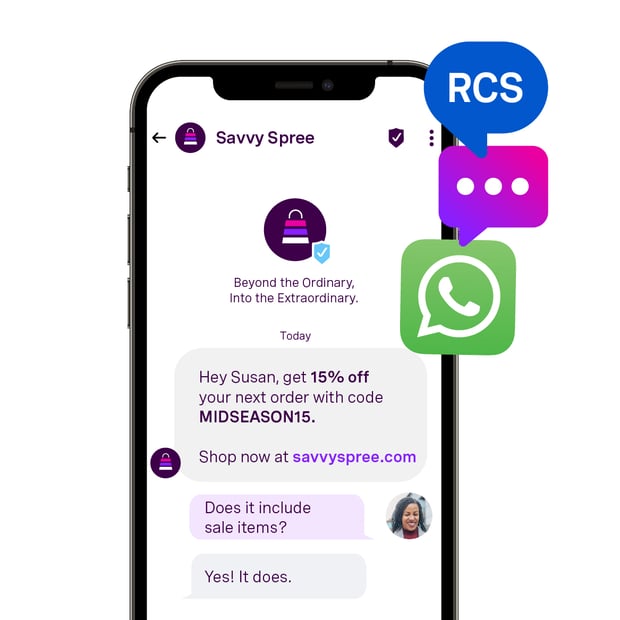
Support multiple formats like SMS, MMS, RCS, WhatsApp, email, and push
Handle delivery tracking, retries, and failure response
Receive inbound messages or replies across channels
Manage sender ID rules, compliance settings, and opt-ins
Supported messaging channels
SMS and MMS – Universal reach and compatibility with all mobile devices
WhatsApp Business – Rich, interactive format with global scale
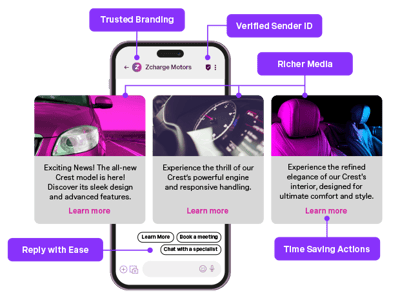
RCS – Modern mobile phone messaging with branding and interactivity
Push notifications – Alerts via mobile apps and browsers
In-app or OTT messaging – Embedded chat within enterprise applications
Primary use cases
Two-factor authentication (2FA) and OTPs
Transactional updates like shipping and payment alerts
Promotional or triggered marketing campaigns
Customer support workflows via messaging channels
App-based engagement and retention programs
Key evaluation factors
Global coverage and local compliance
Cost efficiency across regions and channels
Delivery performance, retries, and fallback
Security features and regulatory adherence
Developer tools and SDK availability
Real-time analytics and delivery insights
How omnichannel messaging APIs handle failover
For businesses delivering messages at global scale, network reliability and channel availability vary by region, device, and user behavior. Omnichannel messaging APIs are built to account for this, using automated failover logic to ensure that each message reaches its destination through the best available route.
What failover means in enterprise messaging
Failover is the process of rerouting a message to an alternate channel or provider if the primary option fails or goes unanswered. For example, if a WhatsApp message isn’t delivered within a certain time window, the system may automatically resend the content via SMS or push notification, depending on user preferences and urgency.
How API-driven failover works
Priority logic defines which channel is attempted first based on factors like urgency, region, or user opt-in.
Timeout settings determine when to trigger the next-best option, like SMS after 30 seconds of undelivered WhatsApp.
Channel eligibility ensures users only receive messages on platforms they’ve opted into or previously engaged with.
Delivery feedback from each channel allows real-time tracking and intelligent retries, improving reliability without spamming users.
Example failover flow
Attempt WhatsApp message with image and CTA button.
If not delivered within 30 seconds, resend via RCS .
If RCS is unavailable or fails, fallback to SMS with plain text content.
Log delivery status across all attempts for reporting and optimization.
Possible messaging scenarios for global brands
These hypothetical scenarios illustrate how enterprise businesses might use a global messaging API to simplify delivery, manage channel preferences, and ensure consistent engagement, without juggling separate integrations.
Coordinating worldwide product launches
A global electronics brand announces a new product line. Using a unified API, the company sends:
Push notifications to mobile app users in North America.
WhatsApp messages with localized offers in India and Brazil.
SMS fallbacks in regions with low data coverage or where users haven’t opted into other platforms.
With automated channel logic and message formatting handled by the API, the launch should be able to run on time across all regions, with no manual routing or duplication required.
Streamlining authentication across platforms
A financial services provider uses the messaging API for secure two-factor authentication (2FA) during sign-ins and transactions. The system:
Sends a WhatsApp verification code if the user has opted in.
Falls back to SMS if WhatsApp delivery fails or is unavailable.
Applies channel-level rate limits and logs all verification attempts for compliance.
By centralizing authentication flows, the company should be able to reduce fraud risk while improving the user experience globally.
Delivering real-time updates across time zones
A logistics company needs to notify customers about shipping delays and delivery updates in real time. The API helps them:
Deliver push alerts to app users in Europe.
Trigger RCS or SMS messages for Android and iOS users in Southeast Asia.
Use Messenger for customer support follow-ups in North America.
The result should be a responsive, omnichannel update system, which should require minimal setup and full visibility across geographies.
Managing opt-in compliance and audit trails
A healthcare technology company sends appointment reminders and secure patient updates across multiple countries. With a global messaging API, they’re able to:
Respect local data protection rules by dynamically adjusting content and timing per region.
Maintain opt-in status per channel (SMS, MMS, WhatsApp, email) and only message users who’ve explicitly subscribed.
Track and log every outbound message and delivery status in a single audit-ready system.
This setup should reduce compliance risk while simplifying campaign coordination for regional teams, all without needing separate tooling per country.
Insight: Businesses using a global messaging API benefit from faster regional rollout, fewer vendor dependencies, and reduced costs compared to managing multiple APIs.
 Customer Engagement
How businesses can integrate a global messaging API
For most enterprises, messaging isn’t a standalone capability, it’s part of a larger ecosystem of applications, data sources, and customer experience platforms. A global messaging API for businesses simplifies integration by acting as a single point of connection across channels and regions.
Key integration points in enterprise systems
CRM and CDP platforms (e.g., Salesforce, Segment) for syncing contact preferences, opt-ins, and message history.
Ecommerce and order management systems to trigger shipping updates, transaction alerts, and promotional flows.
Authentication and identity services (e.g., Auth0, Okta) for sending one-time passwords (OTPs) and verification codes.
Analytics and observability tools to track performance by region, channel, and campaign type.
Developer benefits of a unified messaging API
Single SDK or RESTful API across SMS, MMS WhatsApp, RCS, and push, no need for channel-specific libraries.
Event-based webhooks for real-time updates on delivery status, read receipts, or user replies.
Built-in compliance features like opt-out handling, rate limiting, and sender ID management.
Sandbox environments for fast prototyping and QA before production rollout.
Reducing integration complexity
Instead of managing five separate APIs and mapping content or templates per channel, a global messaging API for businesses lets developers plug into one framework. Message logic, delivery rules, and fallbacks are handled centrally, reducing time-to-market and improving reliability across all customer touchpoints.
Key advantages of unified APIs over fragmented systems
Fragmented messaging systems often emerge from piecemeal growth, one API for SMS, another for WhatsApp, and yet another for push. Over time, this patchwork introduces complexity, inconsistency, and inefficiency at scale.
A global messaging API solves these problems by centralizing delivery, management, and reporting into a single, cohesive platform.
What unified APIs solve for enterprise teams
Reduced engineering overhead. One integration replaces multiple APIs and reduces maintenance cycles.
Faster campaign launches. Shared templates, routing rules, and message logic simplify updates across channels.
Consistent brand experience. Users receive coordinated messages with consistent formatting, timing, and voice.
Improved observability. One analytics layer tracks performance across regions and platforms.
Streamlined compliance. Global opt-in management, rate limits, and audit logs reduce regulatory risk.
Where fragmented systems fall short
Capability
Fragmented Setup
Unified Messaging API
Channel integration
Separate per channel
One API for all
Delivery management
Manual per system
Centralized and automated
Failover and retries
Custom code needed
Built-in and configurable
Data privacy & compliance
Duplicated logic
Managed centrally
Global observability
Siloed dashboards
Unified analytics
When messaging is unified, your teams gain speed and flexibility. Customers, meanwhile, get timely and reliable communication across the platforms they prefer – without dropped threads or duplicated alerts.
Why unified global messaging APIs for businesses are being standardized
As platform complexity grows and customer expectations evolve, leading enterprises are moving away from fragmented messaging setups toward unified APIs that offer scalability, speed, and centralized control.
Vonage Messaging API lets enterprises integrate SMS/MMS, WhatsApp, RCS, Messenger, and more through a single system, with automated failover, channel preference logic, and robust global delivery built in.
Key reasons large organizations choose a unified API
Enables cross-functional consistency, uniting marketing, support, and transactional messaging workflows
Adapts to regional compliance rules like sender ID requirements, opt-ins, and throttling policies
Simplifies global support and scaling, reducing technical debt and vendor sprawl
Allows teams to manage campaigns and messaging without heavy engineering involvement
Provides real-time insights across all channels through unified reporting and delivery tracking
See how a unified API can simplify global delivery while giving your teams more agility and visibility across every messaging channel.
Sign up now
Was this helpful? Let's continue your API journey
Don't miss our quarterly newsletter to see how Vonage Communications APIs can help you deliver exceptional customer engagement and experiences on their favorite channels.

Thanks for signing up!
Be on the lookout for our next quarterly newsletter, chock full of information that can help you transform your business.
Frequently asked questions about global messaging APIs for businesses
A global messaging API is a single interface that allows enterprises to send and receive messages across channels like SMS, MMS, WhatsApp, RCS, and Messenger, while managing delivery, failover, and compliance across regions.
Yes. Unified APIs like Vonage's support multiple messaging formats through a single integration. This reduces the need to manage separate vendors or build channel-specific infrastructure.
It includes built-in failover logic, which automatically routes messages to the next best channel if delivery fails. This helps ensure messages get through, even with network disruptions or regional limitations.
Most advanced APIs allow you to define delivery logic based on user preferences or behavior, such as trying push notifications first, then SMS, or using WhatsApp for opted-in customers.
Global messaging APIs often support opt-in/opt-out tracking, regional sender ID formatting, throttling rules, and full audit trails, helping enterprises meet local regulations and global privacy standards.
Omnichannel platforms focus on customer experience orchestration. A messaging API provides the underlying infrastructure that powers reliable delivery, rich media, and channel logic behind the scenes.
Yes. Delivery receipts, failure reports, open rates, and read indicators are available per channel. These insights can be used to optimize performance and troubleshoot issues across regions.