Two-Way Messaging for Engaged, Real-Time Customer Conversations
Two-way messaging turns simple notifications into dynamic conversations. By creating space for real-time replies, feedback, and richer interactions, businesses reduce message fatigue, improve customer satisfaction, and build stronger relationships across industries.
From one-way alerts to real conversations
Today’s customers expect more than updates. They expect interaction. Traditional one-way messaging, where businesses send alerts, confirmations, or reminders without giving customers a way to respond, is no longer enough.
Business messaging is already conversational at global scale: ~600M people-to-business chats happen every day, and ~80% of people message a business at least weekly, making two-way interactions the norm across chat apps.
Two-way messaging changes that. It allows businesses to engage in real-time, back-and-forth conversations with customers using SMS, MMS, RCS, chat apps, or in-app messaging. The experience becomes dynamic, personal, and responsive instead of transactional and passive.
This approach supports everything from answering product questions and resolving issues to collecting feedback and reinforcing loyalty. Across industries like retail, SaaS, and financial services, two-way messaging helps improve customer satisfaction, reduce time to resolution, and build stronger relationships.
By creating space for dialogue, businesses can deliver messaging that is more useful, more relevant, and more likely to be welcomed.
Five business benefits of two-way messaging
Two-way messaging does more than facilitate communication. It helps businesses create experiences that are personal, scalable, and measurable across the customer journey. Whether supporting a customer in real time or gathering feedback after a transaction, the value goes beyond the message itself.
1. Real-time replies build trust and reduce friction
When customers reach out, they expect answers without delay. two-way messaging enables immediate responses through automation, live agents, or a combination of both. By reducing wait times and eliminating the need to switch channels, businesses can improve satisfaction and reduce churn.
Sample two-way message flows
Practical examples help bring two-way messaging to life:
Retail reminder
Business: “Your order is ready for pickup at Store #123. Reply CONFIRM to let us know when you’re on the way.”
Customer: “CONFIRM.”
Business: “Thank you. We’ll have your order waiting at the service desk.”
Healthcare appointment
Business: “Reminder: Your appointment is scheduled for May 5 at 10 am. Reply YES to confirm or RESCHEDULE for a new time.”
Customer: “RESCHEDULE.”
Business: “Please reply with a preferred date and time. A member of our team will follow up shortly.”
These flows demonstrate how two-way messaging simplifies interactions and reduces the need for calls or emails.
2. Feedback loops that fuel smarter experiences
Customers are more likely to respond to quick, simple messages than long-form surveys. Two-way messaging makes it easy to collect insights through short satisfaction checks or open-ended replies. This data can inform segmentation, product decisions, and service improvements.
3. Loyalty through relevant and personalized messaging
A message that feels tailored is more likely to be read and acted on. Two-way messaging enables personalized communication based on behavior, preferences, or location. By keeping conversations relevant, businesses can strengthen engagement and reinforce loyalty.
4. Lower message fatigue with smarter frequency management
Sending too many messages, or the wrong type, leads to opt-outs. Two-way messaging gives customers more control by allowing them to respond, manage preferences, or pause communication. Businesses benefit from higher retention and better message performance.
5. Richer customer experiences at scale
Modern messaging is not limited to text. With the right tools, businesses can deliver images, quick-reply buttons, or in-app interactions. These richer experiences are made possible through APIs and messaging platforms that support scalability without sacrificing personalization.
Analytics and compliance in two-way messaging
Adopting two-way messaging is not only about creating conversations. It also requires a thoughtful approach to compliance and governance. Businesses need to respect customer preferences, manage consent, and ensure that every interaction builds trust.
Managing preferences and opt-outs
Regulations and customer expectations make it critical to handle opt-ins and opt-outs correctly. Every interaction should give customers clear control over how often they hear from a business and through which channels. Respecting these choices builds trust and helps maintain a positive customer experience.
Two-way messaging must begin with clear customer consent. The most common method is single opt-in, where a customer provides a phone number and agrees to receive messages. Many businesses choose double opt-in, which adds an extra layer of confirmation. For example, a customer who signs up online receives a text asking them to reply YES before they are added to the list. Double opt-in reduces the risk of errors and ensures compliance with regulations such as General Data Protection Regulation (GDPR) and the Telephone Consumer Protect Act (TCPA). It also signals to customers that their consent is taken seriously.
Avoiding message fatigue
Even relevant messages can lose impact if they are sent too often. Two-way messaging allows businesses to balance frequency by using feedback, timing, and preference centers. This ensures customers receive updates that feel timely rather than overwhelming.
The role of compliance
Different regions have specific regulations for messaging, from GDPR in Europe to TCPA and HIPAA in the United States. Businesses must stay informed and use technology that helps them meet these requirements. Compliance is not only about avoiding penalties but also about creating a responsible foundation for customer relationships.
Short codes vs. long codes
Businesses that use SMS for two-way messaging often choose between short codes and long codes. Short codes are five or six digit numbers that are easy to remember and ideal for high-volume campaigns, such as promotions or voting. They can be dedicated to a single business or shared across multiple organizations, with keywords used to route responses.
Long codes look like traditional phone numbers and are well suited for one-to-one interactions, appointment confirmations, or customer support. They are typically more cost effective than short codes and offer a familiar format for customers. Many providers now support 10-digit long codes (10DLC), which allow businesses to use standard numbers at scale.
Choosing between short codes and long codes depends on the type of communication, the expected message volume, and the need for brand recognition.
With compliance and preferences managed responsibly, businesses can turn their focus to how analytics and automation make customer conversations more effective at scale.
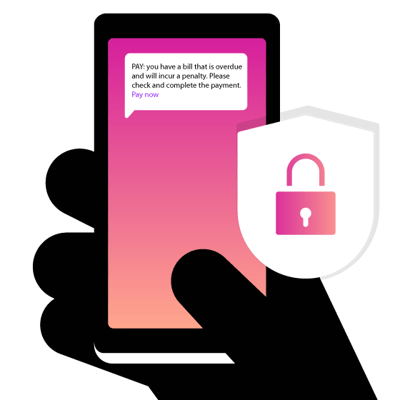 Fight messaging fraud with Vonage Fraud Defender
Types of two-way messaging channels
Businesses can choose from several different channels for two-way messaging, depending on customer preferences and use cases. The most common include:
SMS and MMS
SMS remains one of the most widely used channels, allowing quick, direct communication on virtually any mobile device.
MMS extends this with images, video, and other media to create more engaging conversations.
Rich Communication Services (RCS)
RCS builds on SMS by supporting branded, media-rich messages with buttons, carousels, and real-time delivery insights. It is becoming more widely supported across both Android and iOS devices.
Chat apps
Platforms such as WhatsApp, Facebook Messenger, and Viber allow businesses to connect with customers in the apps they use every day. These channels are particularly effective for international audiences and rich media campaigns.
In-app messaging
Messaging built directly into a company’s own mobile app creates a seamless way to support customers, deliver updates, or gather feedback without requiring them to leave the brand experience.
The right mix depends on customer demographics, industry requirements, and the type of interaction, whether it is a quick confirmation or an ongoing conversation.
Use cases that highlight real-world value
Two-way messaging is adaptable across industries, allowing businesses to meet customers where they are and respond to what they need. From conversion-driven campaigns to service automation, the most effective use cases combine simplicity with immediacy.
Retail: Interactive campaigns that convert
Retailers can use two-way messaging to guide customers through the purchase journey, offer support, and boost loyalty. Messages that confirm orders, answer product questions, or collect post-purchase feedback help turn transactions into ongoing engagement.
Campaigns can also include promotional offers that invite customers to reply with a keyword or tap a quick-reply button. These interactions help brands track interest, personalize follow-ups, and measure campaign impact in real time.
Healthcare: Timely reminders and patient engagement
Healthcare providers can use two-way messaging to confirm appointments, send prescription refill reminders, and collect feedback after visits. Patients can reply to reschedule, ask follow-up questions, or check on test results. This improves accessibility while reducing missed appointments and administrative overhead.
SaaS: Conversations that support and educate
In SaaS, onboarding and customer education are critical. Two-way messaging provides a direct line for users to ask questions, receive guided tips, or resolve issues quickly. Automated flows can help customers discover new features or troubleshoot without leaving the app.
Support teams can also use message data to identify friction points and prioritize improvements. By keeping communication open and responsive, SaaS providers can drive product adoption and retention.
Financial Services: Notifications with built-in responsiveness
For banks, insurers, and fintech companies, two-way messaging can confirm appointments, verify transactions, and provide real-time updates. Customers can respond to alerts, ask follow-up questions, or manage preferences without needing to call or log in.
This reduces service load, improves response times, and helps build trust in critical customer moments.
Travel and hospitality: Smoother journeys and better service
Airlines, hotels, and travel agencies can keep travelers updated with booking confirmations, flight changes, or check-in reminders. Customers can respond directly to rebook, request upgrades, or get local recommendations. These interactions create a smoother travel experience and help businesses build loyalty in a competitive market.
Government and public services: Responsive communication at scale
Public agencies can use two-way messaging to send emergency alerts, gather citizen feedback, and confirm participation in programs. Citizens can respond with questions or updates, creating a more transparent and interactive form of communication that improves trust and engagement.
While these use cases highlight the power of today’s tools, messaging technology continues to evolve.
NextGen two-way messaging: Richer conversations with RCS
As customer expectations grow, messaging is evolving beyond plain text. Rich Communication Services (RCS) represents the next step, combining the reach of SMS with the interactivity of app-based messaging. For businesses, RCS opens the door to branded, media-rich conversations delivered through the default messaging app on a customer’s phone.
RCS ensures trust by displaying the company’s verified name and logo, and supports features like images, videos, quick replies, suggested actions, and real-time read receipts. This allows businesses to guide users through flows such as appointment confirmations, delivery tracking, or product recommendations, all within a single, seamless thread.
Unlike traditional SMS, RCS delivers messages that look and feel more like a native app experience. And because it works through the customer’s default messaging app, no additional downloads are required. In some markets, support for RCS is expanding across both Android and iOS devices, making it a future-ready option for customer communication.
As RCS adoption grows, businesses will gain even more ways to create engaging customer conversations. At the same time, success will depend on the ability to measure performance and automate responses at scale.
How analytics and automation strengthen engagement
As customer conversations grow in volume, businesses need more than the ability to send and receive messages. They need tools that help optimize performance and automate responses without losing personalization. Analytics and automation make two-way messaging smarter and more sustainable.
Optimizing with analytics
Two-way messaging generates measurable data at every step of the interaction. Metrics such as open rates, response times, and conversion outcomes reveal what resonates with customers. By analyzing this data, businesses can refine campaigns, improve timing, and test different approaches through A/B experiments.
Scaling with automation
Messaging automation allows teams to handle thousands of conversations at once while still keeping the experience relevant. Automated flows can greet customers, answer common questions, and route more complex issues to live agents when needed. This combination ensures fast response times without overwhelming service teams.
Personalizing at scale
Programmable messaging APIs enable personalization that goes beyond using a customer’s name. Businesses can adjust interactions based on location, past purchases, or recent behavior. This approach makes communication feel tailored and increases the likelihood of engagement.
Driving long-term value
By combining analytics and automation, businesses can strike the right balance between efficiency and personalization. The result is a messaging strategy that reduces response times, strengthens customer relationships, and delivers consistent value over time.
Why two-way messaging is the key to lasting customer engagement
Two-way messaging is more than a communication channel. It is a strategy that helps businesses create conversations customers value, instead of sending one-way alerts that often get ignored. By inviting responses and enabling real-time interactions, businesses can reduce message fatigue, improve satisfaction, and build loyalty over time.
NextGen customer engagement will be defined by richer, more responsive conversations. Advances such as RCS, analytics, and automation are already making it easier to personalize at scale and keep customers connected in the moments that matter most.
Find out how two-way messaging drives stronger connections and results. Vonage Messages API provides a flexible way to reach customers on their preferred channels, including SMS, RCS, WhatsApp, and social chat apps. It also supports the scale and reliability that modern businesses need.
Sign up now
Was this helpful? Let's continue your API journey
Don't miss our quarterly newsletter to see how Vonage Communications APIs can help you deliver exceptional customer engagement and experiences on their favorite channels.

Thanks for signing up!
Be on the lookout for our next quarterly newsletter, chock full of information that can help you transform your business.
Still have questions about two-way messaging?
Two-way messaging allows businesses and customers to exchange messages in real time. Unlike one-way notifications that only send information, two-way messaging enables a reply from the customer and a response from the business, creating an ongoing conversation.
Customers appreciate being able to ask questions, confirm details, or share feedback without switching channels. Quick responses build trust, reduce frustration, and make the interaction more convenient, which leads to higher satisfaction and loyalty.
Two-way messaging works across SMS, RCS, in-app messaging, and popular chat applications such as WhatsApp, and Facebook Messenger. Businesses can choose channels based on customer preferences and use APIs to manage them from one system.
RCS offers richer features than SMS, including branded messages, images, videos, and quick-reply buttons. These elements can increase engagement by making interactions more visual, trusted, and interactive. SMS, however, remains more universal, so many businesses use both to ensure reach and reliability.
Regulations and best practices require businesses to give customers an easy way to manage communication preferences. This includes clear opt-in and opt-out options, frequency controls, and preference centers. Managing this well helps reduce message fatigue and maintain positive customer relationships.