Multichannel Notifications System for Unified Ecommerce Messaging
Managing customer notifications across channels like SMS/MMS, RCS, WhatsApp, Messenger, and push can quickly become fragmented and costly, especially in high-volume ecommerce environments. A modern multichannel notification system solves this by centralizing messaging workflows through one intelligent platform, improving operational efficiency while ensuring every customer touchpoint is consistent, compliant, and on-brand.
With a unified system in place, teams can reduce engineering load, streamline content updates, and confidently scale communications across geographies and device preferences. Whether you're sending abandoned cart reminders, promotional alerts, or order updates, syncing all your messaging channels from a single source sets the foundation for better customer engagement and brand performance.

-
1.
-
2.
-
3.
-
4.
-
5.
-
6.
-
7.
-
8.
-
9.
-
10.
What is a multichannel notification system?
A multichannel notification system enables you to deliver messages across platforms like SMS/MMS, RCS, WhatsApp, Messenger, and push, through one centralized platform. This approach ensures customers receive critical updates on their preferred device, without requiring your team to juggle multiple tools or integrations. For ecommerce brands, where timing, consistency, and brand trust all impact performance, multichannel systems are a foundational part of the customer engagement stack.
Unlike siloed communication tools, a multichannel notifications system centralizes control over message formatting, delivery logic, and tracking. They allow teams to reach users reliably, adapt messaging for each channel, and manage notifications at scale, without introducing complexity or inconsistency. Whether you're confirming an order, flagging a failed payment, or sending a limited-time offer, a unified system ensures it all works together seamlessly.
How does a unified messaging platform work?
A centralized notification platform simplifies how messages are created, routed, and tracked:
Your application sends a single request to the platform’s API, removing the need for channel-specific integrations.
The system automatically formats the message for each channel, whether it’s an HTML email, an SMS-friendly short message, or rich media for WhatsApp or Messenger.
Intelligent routing logic selects the best channel based on urgency, geography, or user preferences, like sending push first, then SMS if unopened.
Delivery status is tracked across all providers, with built-in retry logic and performance logging, so you maintain visibility at every step.
This flow reduces operational overhead and lets teams scale their communication strategy without engineering bottlenecks.
Common channels and use cases
Email, SMS, MMS, and push notifications are used to handle confirmations, reminders, account alerts, and promotional updates. While SMS offers broad reach, MMS adds visual context like images or QR codes, and push enables real-time, app-based alerts.
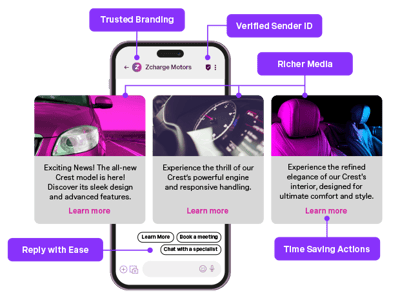
WhatsApp, Messenger, and RCS support rich, branded, and interactive messaging experiences. These channels are ideal for regions with high mobile engagement and allow for features like image carousels, tappable buttons, and two-way conversations, without requiring custom apps.
Common use cases across these channels include fraud alerts, two-factor authentication, shipping updates, cart recovery reminders, loyalty programs, and time-sensitive promotions, ensuring messages are delivered in the format and channel most likely to engage.
Key benefits of this approach
These systems maximize reach by meeting users on the channels they already use and trust.
They improve engagement by aligning message type and format with user expectations, especially in high-performing channels like SMS.
They streamline operations by consolidating message management into one platform, reducing time spent on template updates, delivery logic, and troubleshooting.
Why ecommerce brands need centralized messaging
As ecommerce businesses grow, so does the complexity of their communication stack. What starts as a simple setup, like sending transactional emails or promotional SMS, often turns into a patchwork of disconnected tools, each responsible for one part of the customer journey. Over time, this fragmented approach slows down teams, introduces branding inconsistencies, and makes it difficult to scale.
Each channel comes with its own integration quirks, formatting rules, and delivery limits. Managing them individually means maintaining multiple APIs, debugging issues across different dashboards, and constantly adjusting templates to fit each provider’s requirements. The more channels you add – push, WhatsApp, Messenger – the heavier the lift becomes for your developers, operations teams, and marketers.
The real cost of fragmented messaging isn’t just technical debt, it’s lost opportunity. Customers receive inconsistent messages depending on the platform, or worse, miss critical updates due to delivery errors or conflicting preferences. For ecommerce brands that rely on timely notifications for cart recovery, shipping updates, or loyalty promotions, this can directly impact revenue and retention.
Fragmentation makes branding harder to control
When each team manages its own notification channels, maintaining a consistent voice, tone, and visual identity becomes nearly impossible. Promotional messages might reflect your current brand guidelines, while transactional alerts feel outdated or templated. Disparate tools often lack shared templates or centralized content management, leading to repetitive work and inconsistent customer experiences.
Ready to own your brand across every channel?
Don’t let inconsistent messaging dilute your identity. A unified system helps you protect tone, design, and delivery, at scale.
Scaling exposes technical and operational risks
Without a unified platform, scaling your notification volume introduces friction. Rate limits vary by provider. Retries are handled differently across systems. Message personalization becomes harder to manage. And testing new flows, like switching from SMS to WhatsApp for a given market, requires cross-functional coordination that slows down execution.
Instead of enabling agility, fragmented messaging systems often become a blocker to growth. The cost isn’t just in headcount or developer hours, it’s in slowed campaigns, delayed updates, and missed opportunities to engage customers at the right time, in the right way.
Benefits of unified notifications in ecommerce
Unifying your notification channels under a single platform doesn’t just simplify operations, it fundamentally improves how your brand communicates. For ecommerce teams tasked with delivering consistent, timely, and personalized messages at scale, a centralized notification system becomes a strategic advantage.
Faster execution and updates
With one platform managing all messaging, you can update templates, change routing logic, or launch new campaigns without waiting on engineering. This agility helps you react to real-time trends, run promotions faster, and resolve messaging issues before they impact customers. Your teams spend less time managing tools, and more time optimizing performance.
Consistent branding across every touchpoint
When every message is governed by shared templates and visual standards, your brand shows up the same way across SMS/MMS, RCS, WhatsApp, push, and Messenger. Customers don’t see gaps between promotional and transactional messaging, and that cohesion builds trust, especially during high-stakes moments like order confirmation, delays, or service alerts.
Improved customer experience
Notifications sent through preferred channels tend to be opened faster and acted on more reliably. With intelligent routing and personalization, you can reach users where they’re most responsive, whether that’s an in-app alert, a push notification, or a WhatsApp message. This creates a smoother, more intuitive experience that helps reduce drop-off and increase satisfaction.
In fact, more than 60% of retailers say unified multichannel communication improves customer experience, highlighting its direct link to better engagement and brand loyalty
Operational efficiency at scale
A unified platform eliminates the need to manage multiple vendor contracts, APIs, and dashboards. Instead of piecing together custom logic across systems, your team gains centralized control and visibility, making it easier to test, iterate, and scale as messaging volume grows. It also improves delivery reliability by automatically retrying failed messages, rerouting across fallback providers, and maintaining detailed delivery logs for auditing and optimization. This not only reduces overhead but also improves reliability and speed to market.
 Customer Engagement
Common messaging use cases by channel
Each notification channel offers unique strengths based on delivery speed, user engagement, and regional preferences. A unified system allows you to map specific message types to the channels where they’ll have the greatest impact, without managing each one separately.
SMS and MMS
SMS is ideal for time-sensitive, high-visibility alerts. MMS builds on this with the ability to include media like product images or QR codes.
Common use cases:
Order confirmations, delivery alerts, and payment status updates
Flash sale announcements with visual creative (MMS)
Two-factor authentication (2FA) and account security prompts
SMS remains essential due to its reliability and reach, while MMS is valuable when you want a richer, branded experience without requiring a data connection.
Best for branded, high-engagement messaging in global markets where WhatsApp dominates mobile communication.
Common use cases:
Personalized order updates with tracking links and photos
Cart abandonment recovery with interactive replies
Customer support, appointment confirmations, and feedback flows
WhatsApp Business messaging enables verified communication, supports rich media, and allows for two-way interaction, ideal for transactional and conversational engagement.
Messenger
Works well in social commerce environments where customers are already active on Meta platforms.
Common use cases:
Conversational product recommendations
Order updates through bot flows
Post-purchase surveys or customer care
Messenger allows for dynamic, multi-turn messaging that's effective for mid-funnel engagement and post-purchase retention.
Push notifications
Useful for real-time updates from apps or browsers, especially for time-sensitive, low-friction messaging.
Common use cases:
Inventory alerts, price drops, or restocks
Loyalty reward reminders
Delivery status changes and app re-engagement nudges
Push is lightweight, fast, and cost-effective, particularly when used to trigger action without pulling users into another app.
RCS (Rich Communication Services)
An emerging upgrade to SMS for Android users, RCS supports interactive, branded messaging with no app install required.
Common use cases:
Interactive order confirmations with CTA buttons
Promotional campaigns featuring carousels or embedded video
Event reminders with map links or calendar prompts
RCS gives ecommerce brands a richer, more modern mobile messaging experience, similar to WhatsApp or Messenger, but delivered natively through Android’s default messaging app.
Channel
Order Updates
Cart Recovery
Promotions
2FA & Security
Customer Support
SMS
MMS
Messenger
Push
RCS
Hypothetical examples and applications of multichannel notifications in ecommerce
Below are three hypothetical but realistic scenarios that illustrate how ecommerce teams can use a unified multichannel notification system to improve operations, customer engagement, and message consistency at scale.
Scenario 1: Reducing cart abandonment with cross-channel recovery flows
A fashion retailer notices high cart abandonment on mobile. Using a unified notification platform, the team sets up an automated sequence to recover lost revenue across multiple channels.
A push notification is triggered 30 minutes after inactivity: “Your picks are almost gone, complete your order now.”
If unopened, the platform sends a WhatsApp message with product images and a limited-time discount.
For users without WhatsApp, it falls back to an RCS message with a tappable “Resume checkout” button.
Possible impact: Without building separate workflows, the team would be able to deliver consistent reminders that adapt to each user’s preferred channel, which should help improve recovery rates while preserving brand continuity.
Scenario 2: Streamlining post-purchase updates across regions
A growing marketplace wants to standardize shipping updates across North America, Latin America, and Asia.
In the U.S., SMS and MMS handle confirmations and delivery updates with simple branding elements.
In Latin America and Southeast Asia, WhatsApp is used due to local messaging preferences and high mobile engagement.
Email serves as a fallback for all confirmations and receipts to ensure full coverage.
Possible impact: By managing all delivery logic from one system, the operations team could avoid managing multiple vendor dashboards, while maintaining a consistent experience worldwide.
Scenario 3: Scaling seasonal promotions with localized content
A DTC brand running a Black Friday sale wants to deploy one campaign across multiple formats without creating redundant workflows.
Users with the brand’s app receive a push notification and a dynamic in-app banner.
Subscribers with multimedia support get an MMS with visuals and a time-limited promo code.
RCS messages feature a product carousel with tappable CTAs and location-aware offers.
Possible impact: Marketers could launch a multichannel campaign from a single interface, dynamically adapting content per region, device, and engagement history, with no developer help required.
Overcoming data integration challenges
Unifying your messaging tools is a critical first step, but if your customer data stays disconnected, the experience still breaks down.
Even the best-crafted notifications lose their impact if the underlying data is outdated, inconsistent, or siloed. For ecommerce teams managing messaging across SMS, WhatsApp, Messenger, push, and emerging channels like RCS, syncing data becomes one of the biggest operational hurdles.
Fragmented data leads to messaging breakdowns
When user preferences, engagement history, and order statuses live in separate systems, it becomes nearly impossible to coordinate messages across channels. One customer might receive the same update multiple times, or worse, not at all. Another might get an offer that doesn’t match their purchase behavior or location.
Even with centralized messaging workflows, backend data systems can remain fragmented. Each channel’s provider may use a different data format, webhook structure, or rate limit policy, creating sync challenges that go beyond simple delivery.
Stitching them together often requires custom code, data mapping, and constant monitoring, draining engineering time while increasing the risk of errors.
Why a unified platform simplifies data sync
Centralized notification systems address these problems by integrating with your data sources directly, CRM, ecommerce platforms, analytics tools, so every message reflects real-time context and consistent business logic.
User preferences and opt-ins are managed centrally, reducing the chance of sending messages through a channel the user has opted out of.
Behavioral data and segmentation syncs in real time, so abandoned cart flows, loyalty updates, or post-purchase messages are timely and accurate.
Template logic adapts content based on customer attributes, like preferred language, product category, or last engagement channel.
Fallback across messaging providers can also be configured, ensuring critical messages still reach users even if one provider experiences downtime or delivery issues.
The result is not just better messaging, it’s smarter messaging that reflects your customer’s journey in real time, without requiring complex integrations across tools.
Best practices for multichannel notifications
Effective multichannel messaging isn't just about choosing the right platform, it’s about building a consistent, scalable communication strategy that works across all touchpoints. Below are proven practices that help ecommerce teams get the most value from a unified notification system while protecting user trust and brand consistency.
Maintain consistent branding across channels
Your customers should recognize your brand whether they’re reading a WhatsApp message, viewing an SMS alert, or tapping a push notification. To achieve this:
Use consistent tone, language, and structure across all message types.
Ensure visual elements (like logos or colors in MMS/RCS) align with your brand guidelines.
Centralize templates in a shared system so marketing and product teams stay in sync.
Pro tip: Build reusable message components, headers, footers, disclaimers, that can be adapted for different formats without starting from scratch.
Compliance tip: Messaging regulations vary by region. Be sure to centrally manage opt-in/opt-out preferences and follow country-specific rules such as TCPA, GDPR, or CASL to avoid legal and reputational risk.
Design for the constraints of each channel
Each messaging format comes with its own technical and UX limitations. Respecting these constraints improves readability and avoids delivery issues:
SMS. Stick to 160 characters. Place links early.
Push. Use action-driven language and short phrases.
WhatsApp, RCS, MMS. Leverage rich media, CTA buttons, and personalization, where supported.
Insight: Before launching any campaign, test content across channels and devices to catch formatting errors and preview the full user experience.
Build smart routing logic
Not every message belongs on every channel. Use intelligent routing rules to balance urgency, cost, and user preference:
Try push first for low-cost, high-speed notifications.
Use SMS or WhatsApp for time-sensitive or mission-critical updates.
Set fallbacks so that if one channel fails or is ignored, another kicks in automatically.
Common mistake: Sending the same message to every channel at once. This increases opt-outs and reduces trust. Let your platform handle conditional delivery based on behavior or delivery status.
Monitor performance and iterate
Use built-in analytics to track open rates, click-throughs, delivery failures, and engagement by channel.
Identify which formats perform best for each use case.
A/B test content variations and delivery timing.
Continuously refine templates based on real-world results.
When managed centrally, this level of insight becomes a growth lever, not just a reporting tool.
Why unified messaging is now a must for ecommerce
As customer expectations rise and messaging channels multiply, ecommerce teams need more than piecemeal tools, they need a platform strategy. A unified notification system doesn’t just simplify operations. It enables your teams to deliver branded, responsive, and data-driven messaging across SMS, WhatsApp, push, RCS, MMS, and social chat apps, all without fragmenting the customer experience.
Scaling notifications shouldn’t require duplicating workflows, managing multiple APIs, or trading speed for consistency. When every message flows through a central, intelligent platform, your teams gain control, agility, and insight, all while your customers receive messages that feel timely, relevant, and on-brand.
For organizations exploring how to simplify multichannel execution, improve engagement, and reduce messaging complexity, Vonage Messages API offers a flexible solution. It connects your business to SMS, MMS, RCS, and popular social messaging apps, helping you unify communications and deliver seamless customer experiences at scale.
Sign up now
Was this helpful? Let's continue your API journey
Don't miss our quarterly newsletter to see how Vonage Communications APIs can help you deliver exceptional customer engagement and experiences on their favorite channels.

Thanks for signing up!
Be on the lookout for our next quarterly newsletter, chock full of information that can help you transform your business.
Frequently asked questions about multichannel notifications
Multichannel messaging refers to using multiple communication channels (like SMS, push, and WhatsApp), often managed separately. Omnichannel messaging takes this further by unifying the customer experience across all channels, ensuring consistency, continuity, and shared context throughout the journey.
Yes. Modern messaging APIs allow you to send and manage communications across SMS, MMS, WhatsApp, Messenger, RCS, and more, without separate integrations for each. These platforms streamline delivery, template control, and analytics across all supported channels.
Centralizing templates reduces duplication, ensures brand consistency, and speeds up message updates. When all channels pull from the same structured templates, teams can update content once and deploy it instantly across every touchpoint.
Routing logic lets you define delivery rules, for example, “Send via push, but fall back to SMS if unopened in 10 minutes.” This ensures messages reach users through the best channel based on urgency, availability, or user preference.
RCS is supported on many Android and iOS devices and continues to expand globally. While it’s not as universal as SMS yet, it offers rich features like carousels, branded layouts, and embedded CTAs, making it valuable where available.
Yes. Channels like MMS and RCS support images, video, and interactive elements without requiring users to download an app. These are ideal for promotional campaigns, confirmations, or branded updates.
Most messaging APIs include delivery status callbacks and analytics dashboards. You can track when a message was sent, delivered, read, or failed, channel by channel. This helps with reporting, optimization, and issue resolution.