Unified Messaging Platform API To Connect All Your Channels
Channel sprawl is making communication harder for enterprise teams. Whether it's marketing sending SMS, operations using WhatsApp, or support relying on chat apps, managing messaging across tools creates friction, delays, and inconsistencies that grow worse at scale.
A unified messaging platform solves this by centralizing every communication channel, SMS, RCS, WhatsApp, Messenger, and more, into one API and dashboard. This empowers teams to streamline execution, standardize branding, automate delivery logic, and adapt messages based on real-time customer behavior, all without juggling multiple systems. For businesses seeking simplicity, scalability, and control, a unified platform becomes more than a tool, it’s infrastructure for growth.
-
1.
-
2.
-
3.
-
4.
-
5.
-
6.
-
7.
-
8.
-
9.
-
10.
-
11.
-
12.
-
13.
-
14.
-
15.
What is a unified messaging platform?
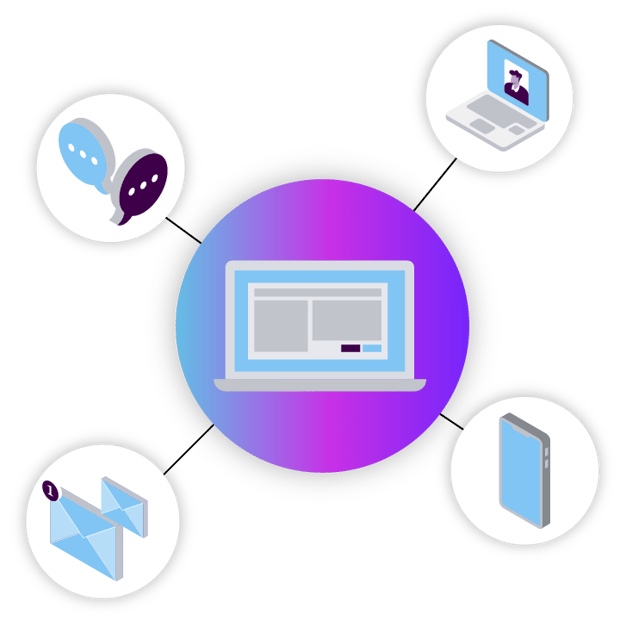
A unified messaging platform brings together email, SMS notifications, chat apps, voicemail, social messaging, and in-app conversations into a single shared environment. Instead of switching between tools, inboxes, and dashboards, teams manage all customer and internal messaging from one interface. This centralization simplifies daily workflows, improves visibility across conversations, and supports smoother collaboration as interactions move between channels and teams.
By combining communication streams into one system, unified messaging platforms make it easier to maintain context, reduce response delays, and coordinate handoffs without losing message history. As message volume grows, this approach helps organizations manage customer interactions and internal collaboration more efficiently from one place.
Key features of a unified messaging platform
A consolidated inbox that brings messages from SMS, WhatsApp business messaging, email, chat apps, and other channels into a single view
Multichannel support that allows teams to manage text messaging, social messaging, live chat, email, and in some cases voicemail from one platform
Voicemail transcription capabilities that convert audio messages into readable text for faster review and follow-up
AI-assisted tools that support conversation summaries, suggested replies, and workflow automation to reduce manual effort
Collaboration features that allow teams to assign, transfer, or take over conversations without breaking continuity
Centralized management for phone numbers, templates, routing rules, and reporting through one dashboard
Benefits of using a unified messaging platform
Saves time by reducing the need to switch between multiple messaging tools
Improves customer experience by preserving conversation history across channels
Boosts team productivity through simplified workflows and clearer ownership
Scales easily as message volume and team size increase, without adding operational overhead
Why messaging fragmentation slows down enterprise teams
Managing customer communications across multiple tools might seem manageable early on, but it rarely scales well. As businesses expand their channels from SMS and WhatsApp to RCS, email, live chat, and in-app messages, the operational burden of fragmented systems becomes harder to ignore. Disjointed messaging stacks slow down workflows, introduce inconsistencies, and create barriers between departments that need to act fast and stay aligned.
Each disconnected channel introduces its own set of constraints, different APIs, dashboards, message formats, compliance rules, and reporting systems. This complexity forces engineering teams to build and maintain redundant integrations, while marketing and operations teams juggle siloed tools that don’t share templates, logic, or analytics. When these systems don’t communicate with each other, your messaging strategy becomes more reactive than proactive.
Where fragmentation causes friction
Operational delays happen when campaigns or alerts must be rebuilt or re-approved for each channel. Teams often duplicate work for SMS, WhatsApp, push, and email, instead of executing from a shared playbook.
Brand inconsistency creeps in as different teams manage different tools. One team might send on-brand messages through Messenger, while another sends templated SMS alerts with outdated copy.
Lost visibility becomes a challenge when delivery, engagement, and opt-out data live in separate systems, making it harder to optimize or report on performance across channels.
Scaling issues grow with your audience. Adding more regional markets or customer segments often means adding more tools, unless your messaging infrastructure is already unified.
Increased compliance risk emerges when local opt-ins, rate limits, or content rules are applied differently across systems, especially when those tools aren’t governed centrally.
How this impacts teams at scale
As messaging campaigns become more time-sensitive and globally distributed, enterprise teams need tools that allow for fast iteration and clear accountability. Fragmented systems slow this down. Instead of launching a campaign from one interface, teams spend time syncing with multiple vendors, copying message templates, resolving API failures, or manually reconciling analytics.
A unified messaging platform eliminates these points of friction by acting as a central control layer across all channels. Operations, marketing, and customer service teams can align on one platform that handles everything from template versioning and channel logic to performance tracking and opt-out enforcement.
Pro tip: If your teams spend more time managing messaging tools than engaging customers, that’s a strong sign your infrastructure is fragmented, and likely holding you back from faster growth.
Unified messaging platform vs. traditional tools
Traditional communication systems were never built to handle today’s multi-channel, multi-region engagement needs. Most enterprises still rely on a patchwork of tools, one for SMS, another for WhatsApp, a different one for email, plus separate dashboards for customer service, marketing, and operations. This setup might get the job done in isolated workflows, but it becomes unmanageable as scale and expectations increase.
A unified messaging platform (UMP) takes a different approach. Instead of managing each channel individually, UMPs provide a single control layer for all communication, from API delivery to team collaboration and performance tracking. This shift doesn’t just simplify tool sprawl, it transforms how teams plan, launch, and optimize messaging across the customer journey.
Core differences between unified platforms and traditional tools
Capability
Traditional Messaging Stack
Unified Messaging Platform
Channel integration
One tool per channel
All channels connected in one platform
Team collaboration
Siloed systems for support, ops, marketing
Shared workspace across functions
Message routing & failover
Manual or separate per tool
Centralized, automated logic
Opt-in and compliance tracking
Managed per vendor
Unified and audit-ready
Campaign speed
Delays from tool-hopping and versioning issues
Single-click updates across all channels
Insights and analytics
Fragmented dashboards
Consolidated reporting with full context
Scalability
Requires tool-by-tool growth
Built to scale across use cases and regions
Why traditional systems struggle under scale
Legacy systems often force teams to duplicate effort, writing one message for SMS, another for WhatsApp, and still another for push. Each update takes more time. Each test is harder to measure. And each campaign creates new chances for inconsistency or error. For global brands or growing teams, these limitations cost more than just time, they affect brand perception and customer experience.
Unified messaging platforms solve this by treating messaging as a single system, not a stack of tools. Content, delivery, logic, compliance, and analytics are all managed from the same interface, and the same API. Whether you’re onboarding new users, re-engaging dormant ones, or updating customers in real time, this unified layer removes unnecessary work and technical friction.
Insight: Businesses switching to a unified platform often see improvements in team productivity, message consistency, and response rates, simply by removing silos and syncing every channel from one system.
How a unified API connects all your channels
A unified messaging API acts as the central nervous system for enterprise communication. Instead of building separate workflows for SMS, WhatsApp, RCS, in-app chat, or other messaging channels, you connect once, and control them all. This simplifies how messages are composed, routed, delivered, and tracked, while enabling smarter automation across every interaction.
When done right, a single API integration replaces multiple vendor touchpoints and reduces technical overhead for both developers and operations teams. Whether you're sending real-time alerts, coordinating global campaigns, or handling support interactions, a unified API provides omnichannel customer support and ensures everything stays connected, responsive, and consistent.
SMS, WhatsApp, RCS, and in-app chat
Today’s messaging landscape is made up of both carrier-based and app-based platforms. Each comes with its own formatting, delivery rules, and regional preferences. A unified messaging platform standardizes these differences behind the scenes, allowing your team to:
Deliver time-sensitive alerts via SMS when reliability is essential
Use WhatsApp for rich engagement in markets where it dominates
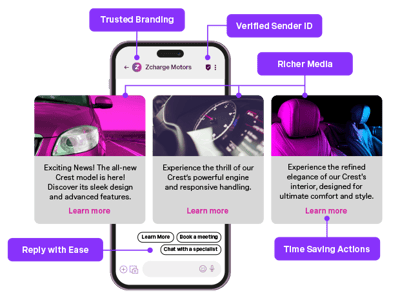
Leverage RCS for branded, interactive experiences on Android and iOS devices
Send in-app or web chat messages for authenticated users within your product
This channel flexibility is critical for enterprises communicating across countries, languages, and device types, especially when user expectations vary by region.
Channel preference logic and fallback flows
With built-in delivery intelligence, unified messaging APIs can automatically choose the best channel based on:
User preferences (e.g., opt-ins or previous behavior)
Device type and messaging availability
Message type (e.g., urgent alerts vs. promotional updates)
For example, an order confirmation might be sent via WhatsApp first. If undelivered after 30 seconds, the platform could retry with SMS or push, ensuring delivery without requiring engineering to build manual logic or fallback infrastructure.
This type of automated failover protects the customer experience and maximizes reach, even when channel conditions are unpredictable.
Real-time delivery tracking and analytics
Visibility is another major advantage. With one dashboard and API, teams can monitor:
Delivery status and failure reasons by channel
Read receipts and engagement data (where supported)
Channel usage trends by geography or campaign
API performance and volume spikes
These insights make it easier to test, optimize, and scale communication across business units. You can also integrate this data with your analytics stack or CRM for a more complete view of user interactions.
Key use cases for operations, marketing, and support
A unified messaging platform isn’t just about simplifying infrastructure. Its real power lies in how it enables business teams, operations, marketing, and support, to deliver consistent, timely, and scalable communication across every channel. With one system in place, organizations can execute high-impact messaging strategies without relying on siloed tools or cross-functional workarounds.
Operational notifications that drive efficiency
Operations teams depend on accurate, real-time updates to manage logistics, appointments, and internal workflows. A unified platform lets them trigger messages automatically based on system events or user actions.
Shipping and delivery alerts. Send SMS updates with fallback to WhatsApp or push, ensuring packages are tracked across devices.
Appointment confirmations. Automate reminders via RCS, in-app, or email, depending on customer preferences.
Service disruptions. Trigger urgent notifications with guaranteed delivery using SMS and failover to other channels.
With centralized routing logic and templates, operations teams can reduce delays and missed connections, while cutting manual overhead.
Marketing campaigns with better reach and personalization
Marketing teams benefit from the ability to design once and deliver everywhere. Campaigns can dynamically adapt based on user engagement, device type, and preferred channels, all without switching tools.
Promotional offers. Deliver rich media campaigns over MMS, WhatsApp, or RCS with fallbacks to plain-text SMS.
Abandoned cart nudges. Trigger push notifications first, then follow up with WhatsApp or SMS for higher conversion.
Geo-targeted alerts. Tailor messages per region using one template and the platform’s built-in localization and routing tools.
By integrating with CRMs and CDPs, marketers can personalize outreach based on customer history, preferences, and behavior, all while maintaining brand consistency.
Support workflows with omnichannel responsiveness
Support and customer service teams use unified messaging to reduce response times and improve satisfaction. With all channels visible in one dashboard and replies routed automatically, agents stay efficient and customers stay heard.
Two-way messaging. Enable replies over WhatsApp, Messenger, or SMS, with all threads visible in one interface.
Chat deflection. Direct inbound inquiries from web chat to SMS or WhatsApp for mobile convenience.
Escalation workflows. Route urgent cases to human agents while automating follow-ups and status updates.
Support teams gain context and continuity across sessions, and customers no longer have to repeat themselves when switching channels.
 Customer Engagement
Hypothetical examples of coordinated communication
Below are three hypothetical scenarios that illustrate how enterprise teams can use a unified messaging platform to orchestrate efficient, on-brand communication across multiple channels. These examples reflect realistic challenges and solutions based on how unified messaging is used in practice.
Scenario 1: Coordinating a high-volume product launch
A consumer electronics brand is preparing to launch a new device across North America, Europe, and Southeast Asia. The marketing team wants to reach audiences on their preferred channels without duplicating work across tools or teams.
Using a unified messaging platform, they:
Schedule push notifications for app users in the US and UK with preorder CTAs.
Send WhatsApp messages with localized promotions in India and Brazil.
Use RCS for Android and iOS users in Southeast Asia with interactive product carousels.
Set fallback rules to SMS in regions where other channels fail or aren’t opted in.
Possible impact: The global campaign is deployed from one dashboard, which should allow for region-specific targeting, consistent branding, and automatic fallback, all without cross-team handoffs or manual channel routing.
Scenario 2: Streamlining customer service alerts and updates
A financial services provider wants to ensure customers receive fraud alerts, account updates, and service disruptions in real time, without delays or missed messages.
With unified messaging, the operations team:
Sets up alert triggers from their fraud detection system to dispatch messages instantly.
Delivers WhatsApp or push notifications to users with app or opt-in preferences.
Fails over to SMS when high-priority messages aren’t acknowledged.
Routes incoming replies to the appropriate support team with conversation context.
Possible impact: Customers would receive alerts quickly and on their preferred channel, which should reduce support tickets while preserving trust. The support team should also be able to avoid jumping between dashboards to track responses.
Scenario 3: Supporting flash sales with real-time engagement
A fast-fashion retailer plans a 48-hour flash sale with dynamic inventory and segmented offers across multiple countries. They need to notify users instantly, handle real-time feedback, and avoid duplicate outreach.
Using a centralized messaging API and dashboard, the marketing team:
Sends RCS messages with clickable outfit galleries to Android and iOS users.
Delivers push and in-app messages to loyalty app subscribers.
Uses Messenger for personalized follow-up reminders the next day.
A/B tests MMS vs. WhatsApp creatives to optimize clicks and conversions.
Possible impact: The entire campaign would be coordinated in one place, with automatic preference-based routing and performance reporting. This should enable rapid iteration and maximize engagement during a time-sensitive promotion.
At a glance: Coordinated messaging scenarios across channels
Scenario
Channels Used
Unified Features
Value Delivered
Global product launch
Push, WhatsApp, RCS, SMS fallback
Geo-based routing, fallback logic, single dashboard
Faster launch coordination, brand consistency, reduced duplication
Customer service alerts
WhatsApp, push, SMS
Real-time triggers, reply routing, opt-in logic
Timely alerts, better CX, reduced support load
Flash sale campaign
RCS, in-app, push, Messenger, MMS
A/B testing, user segmentation, centralized templates
Higher engagement, rapid iteration, global reach
Integrating a unified platform into existing systems
For most enterprise teams, messaging does not operate in a vacuum. It supports and interacts with critical systems across operations, marketing, support, and commerce. A unified messaging platform is most effective when it integrates directly into the broader digital ecosystem, connecting seamlessly with tools your teams already use.
CRM, ecommerce, authentication, and more
The value of a unified messaging API increases significantly when paired with your core business systems. These integrations enable automated, contextual communication that improves speed and accuracy across customer touchpoints.
Customer relationship management (CRM)
Syncing your messaging platform with systems like Salesforce or HubSpot allows teams to deliver more relevant and timely messages. Message logs, opt-in preferences, and engagement history can be tied directly to customer records, making personalization easier and improving support efficiency.
Ecommerce and order management
Whether using Shopify, Magento, or custom platforms, integrating your messaging API helps automate transactional alerts. These include shipping updates, payment confirmations, restock notifications, and delivery follow-ups, all triggered in real time based on order status.
Authentication and identity services
For businesses that require secure logins or transaction approvals, tying messaging flows to identity platforms like Auth0 or Okta enables dynamic two-factor authentication. Messages are sent instantly, routed to the user’s preferred channel, and logged securely for compliance.
Analytics and business intelligence tools
Integration with analytics platforms helps teams analyze performance across campaigns, channels, and regions. Real-time visibility into open rates, delivery failures, and engagement trends allows continuous optimization and troubleshooting.
Developer tools and onboarding advantages
Modern unified messaging platforms are designed to reduce friction for technical teams during onboarding and integration. This allows businesses to deploy messaging quickly, without months of custom development.
One SDK or API for all channels
Instead of piecing together five different APIs, developers can use a single SDK or RESTful API that covers SMS, WhatsApp, RCS, Messenger, and push. This simplifies architecture, speeds up development, and reduces maintenance overhead.
Event-driven webhooks
Messaging platforms can send callbacks to your systems in real time when a message is delivered, read, failed, or replied to. This event-driven approach enables dynamic workflows, like escalating a failed 2FA code or triggering an email backup if SMS fails.
Sandbox environments for testing
Most enterprise-ready platforms include sandbox or staging environments, allowing development teams to build and QA message flows before they go live. This reduces production risk and supports agile development cycles.
Rate limiting, opt-out logic, and compliance features
Built-in capabilities like throttling, per-region controls, and opt-in management reduce the amount of custom code developers need to write. This helps teams stay focused on business logic instead of infrastructure.
Streamlining team collaboration and execution
One of the most overlooked advantages of a unified messaging platform is how it transforms internal workflows. When operations, marketing, and support teams all rely on the same messaging infrastructure, with shared templates, logic, and reporting, they spend less time coordinating and more time executing.
Centralized control for operations and marketing
In traditional setups, each team might manage its own messaging system. Support uses one tool for SMS updates, marketing uses another for campaign pushes, and operations might have yet another for delivery notifications. This decentralization creates silos, duplication, and delays.
A unified messaging platform changes this by providing:
A shared dashboard where teams can view and manage all active and scheduled messages
Centralized template libraries to ensure consistent voice, tone, and branding across departments
Role-based access control so teams can collaborate without stepping on each other's workflows
Real-time visibility into message performance, delivery status, and channel health
When everyone operates from the same interface, it’s easier to launch campaigns, troubleshoot issues, and share insights.
Shared templates, workflows, and audit history
Template consistency is critical in regulated industries and global brands. A unified system allows teams to store, reuse, and adapt message templates, whether for abandoned carts, service alerts, or verification codes.
Templates are updated once and propagated across all relevant channels.
Pre-approved flows reduce the need for legal or brand reviews on each campaign.
Version control and history tracking ensure you can see what changed, when, and why.
This reduces the need for manual QA and keeps messaging aligned with brand and legal standards.
Pro tip: Create a shared message taxonomy, grouping templates by type, audience, and channel, to reduce duplication and speed up campaign creation.
Reducing internal friction
With a unified messaging platform in place, operations and marketing no longer need to rely on developers for every change. Teams can:
Clone and adjust templates based on performance data
Launch A/B tests across multiple channels without writing new code
Shift messages between channels (e.g., from WhatsApp to RCS) based on availability or engagement
Share performance dashboards to inform broader CX strategies
The result is faster execution, clearer accountability, and a messaging system that scales with your internal workflows, not against them.
How unified messaging scales with your business
Scalability is one of the defining characteristics of a well-architected messaging solution. As your user base grows, your messaging volume will rise in parallel, spanning new channels, markets, use cases, and regulations. A unified messaging platform helps you grow without introducing the complexity that typically comes with scale.
Simplifying growth across teams and regions
Global expansion brings added pressure to your messaging infrastructure. You need to manage language localization, time zone differences, country-specific delivery regulations, and regional channel preferences, all while keeping messages on-brand and on-time.
A unified messaging platform gives you:
Pre-built support for multiple channels, including SMS, WhatsApp, RCS, Messenger, in-app messaging, and more
Localization tools to adjust templates and routing logic per region or language
Compliance configurations to meet data privacy, opt-in, and sender ID requirements in each geography
Scalable workflows that empower regional teams to launch local campaigns without reinventing the architecture
This setup ensures consistency at the core, while still offering flexibility at the edge.
Insight: Global brands often underestimate the operational complexity of scaling messaging. A unified platform abstracts that complexity so your teams don’t need to.
Ensuring performance under increasing volume
When message volume doubles (or more), most legacy systems start to buckle. Rate limits get hit. Delivery times lag. Monitoring becomes harder. A unified messaging platform, built with scale in mind, counters this by:
Providing built-in load balancing and message throttling across channels
Using smart retries and automated failover to maintain high delivery rates
Offering flexible APIs that support burst traffic without hitting performance ceilings
Exposing real-time metrics on delivery latency, throughput, and error trends
This performance resilience ensures your critical notifications, like 2FA codes, payment alerts, or downtime warnings, still reach customers reliably, even during spikes.
Future-proofing your messaging architecture
As new channels emerge (or old ones evolve), a unified platform lets you adopt without disruption. Instead of building new integrations from scratch, you extend your existing API logic and governance policies to new endpoints.
This means:
You can test emerging platforms like Instagram DMs or new RCS formats without touching core infrastructure.
New regions or partners can be onboarded through existing workflows.
Your teams spend less time maintaining integrations, and more time optimizing experiences.
Common mistake: Trying to scale with siloed systems often leads to duplicate work and delivery errors. Consolidation early on pays off in speed and stability later.
The ROI of a unified messaging platform
Switching to a unified messaging platform is more than a technical upgrade, it’s a business investment that drives measurable returns across teams, regions, and channels. By consolidating infrastructure and standardizing communication workflows, organizations can reduce costs, increase productivity, and improve campaign performance in ways fragmented systems can’t match.
Lower operational costs
Managing separate APIs, integrations, and dashboards for every channel adds up, especially as teams grow. A unified platform eliminates the need for redundant development work, custom logic per system, and siloed vendor contracts.
One platform reduces licensing and support costs from multiple providers
Engineering teams spend less time maintaining fragile, custom-built integrations
Centralized templates and routing reduce duplication in campaign setup
Increased campaign efficiency
Marketing and operations teams spend less time re-creating assets, coordinating with developers, or waiting for approvals across tools. With shared logic and pre-approved workflows, campaigns launch faster, with fewer errors.
Faster time-to-launch across channels
Fewer touchpoints needed to build or test new message flows
Consistent branding and voice without additional oversight
Improved message performance
A unified messaging API supports real-time delivery tracking, intelligent channel routing, and automated fallback, all of which increase the likelihood that messages are delivered, seen, and acted on.
Higher engagement from delivering on users’ preferred channels
Fewer missed or failed messages thanks to automated failover
Optimized delivery timing and format based on analytics
Scalable growth without rework
As your business expands into new markets or use cases, a unified platform can adapt without requiring new tooling or architecture. This reduces the cost and time typically needed to onboard new regions or support new formats.
Global expansion supported with localization and compliance logic
New teams or products added without duplicating setup
Future messaging channels integrated through existing APIs
Governance and compliance made easier
Managing compliance across multiple messaging channels isn’t just time-consuming, it’s risky. Fragmented systems make it harder to track opt-in status, enforce regional regulations, or audit communication history. A unified messaging platform simplifies governance by centralizing compliance controls, permissions, and oversight across all customer interactions.
When every message flows through a single platform, businesses gain visibility and control that’s hard to achieve with disconnected tools. Consent records, channel permissions, and content policies are enforced consistently, no matter where the message is sent or which team is managing it.
Why unified compliance matters
Global regulations such as GDPR, HIPAA, and TCPA require clear records of customer consent and message delivery. Managing these rules independently across SMS, WhatsApp, RCS, Messenger, and in-app chat can lead to gaps in enforcement, and potential penalties.
A unified platform helps prevent this by:
Storing opt-in and opt-out data centrally, ensuring consistent handling across all channels
Automating compliance enforcement by region, including rate limits, quiet hours, and content filters
Logging message history with timestamps and delivery status for audits and dispute resolution
Supporting sender ID formatting and throttling rules tailored to local carrier requirements
For example, if a user opts out via SMS, that preference is automatically honored across all messaging formats, including push or WhatsApp, without requiring manual syncing between tools.
Built-in audit trails and access control
Security and accountability go hand in hand. Unified messaging platforms provide role-based access control, ensuring only authorized users can send or manage messages. Teams can also:
Track who scheduled or edited a campaign
Monitor approval workflows and version history
Export message logs filtered by channel, date, or audience segment
These features aren’t just helpful during audits, they support smoother internal collaboration and reduce compliance risk at scale.
Supporting global governance from one place
Whether you're operating in 3 markets or 30, a centralized messaging solution can adapt to local privacy requirements without creating chaos. Instead of hardcoding per-country rules into multiple systems, enterprises can manage preferences, content guidelines, and data residency from one dashboard.
Insight: Compliance isn’t just a legal checkbox, it’s part of the customer experience. Customers are more likely to engage when they trust your brand to respect their preferences across every channel.
What to look for in a unified messaging API
As you evaluate platforms, think beyond “can it send a message?” and ask: can it do so reliably, securely, and intelligently, at scale? For enterprises managing complex customer lifecycles across multiple regions and departments, your messaging API should be more than functional. It should be foundational.
Start with security, privacy, and compliance
Security and compliance aren’t bonus features, they’re baseline requirements. Your platform should offer:
End-to-end encryption and JWT-based authentication
Localized compliance support (e.g. GDPR, HIPAA, TCPA)
Tools to manage opt-ins, opt-outs, and suppression lists
Access control and permissions for operational security
A full audit trail of delivery and interaction events
Don’t assume every provider meets these standards by default, especially when global expansion is part of your roadmap.
Evaluate how “unified” the API really is
Some APIs are multi-channel in name only. What you need is true abstraction, one API structure, one logic framework, across every supported channel.
Ask these questions:
Does the API use consistent message formats for SMS, WhatsApp, RCS, and others?
Are webhooks and delivery callbacks unified across channels?
Can templates and campaigns be reused with minimal rewrites?
If your team has to build a separate workflow per channel, it’s not a unified platform, it’s a patchwork.
Look for automation and adaptive logic
Modern enterprise messaging is more than one-way communication. Your platform should adapt in real time, choosing the right channel, retrying failed messages, and personalizing content without manual input.
Here’s what that looks like in practice:
Capability
Purpose
Channel fallback
Deliver via WhatsApp, fall back to SMS or push
User preference routing
Send messages on the user’s last-engaged platform
Message formatting
Auto-adapt content for each channel's format limits
Trigger-based messaging
Automate sends based on events (e.g., signup, checkout)
These features reduce errors, avoid duplicated messages, and ensure users receive content where they’re most likely to act on it.
Insist on visibility and insight
What gets measured gets improved. Your messaging API should give every team, from engineering to marketing, access to performance data that fuels smarter decisions.
What to expect:
A centralized dashboard for monitoring campaigns across all channels
Real-time delivery tracking with retry logic and status codes
Exportable reports with filters for channel, region, and audience segment
Insight into customer engagement, not just delivery
Combined, these tools help you spot issues fast, refine strategies, and demonstrate ROI across the org.
Choosing a platform built for scale
Selecting a unified messaging platform isn’t just about what it can do today, it’s about what it will enable tomorrow. For enterprise teams managing global communication across departments, audiences, and markets, scale isn’t optional. It’s expected. The right platform should meet today’s technical demands while anticipating tomorrow’s growth, complexity, and innovation.
What scale really means for enterprise messaging
Scalability is more than sending a higher volume of messages. It involves supporting:
Global delivery without degradation, even during seasonal or event-driven spikes
Thousands of concurrent workflows, managed by cross-functional teams in different regions
Emerging channels like Instagram DMs or embedded chat, without rebuilding infrastructure
Real-time data handling for alerts, verification, personalization, and analytics
The best-fit platforms are designed with horizontal scale in mind, using distributed architecture, adaptive routing, and elastic infrastructure to grow with your business.
How to future-proof your messaging infrastructure
To avoid costly replatforming down the line, evaluate providers based on their ability to evolve with your needs. Here’s what to look for:
Capability
Why It Matters
Modular architecture
Easily add new channels, features, or geographies without breaking existing flows
Service-level guarantees (SLAs)
Ensure message delivery, latency, and uptime commitments are enforceable
Global support footprint
Access live support across time zones, especially during business-critical windows
Transparent roadmaps
See how the provider plans to support new protocols, compliance changes, or AI capabilities
Enterprise governance tools
Role-based access control, change logs, and audit trails support internal scaling and compliance
Reducing vendor lock-in
While every API integration creates some degree of dependency, the right platform should offer enough interoperability and standards compliance to avoid lock-in.
Prioritize:
Channel-agnostic logic (e.g. one template used across SMS, RCS, and WhatsApp)
Portable data formats for messages, responses, and logs
Flexible deployment options, including hybrid or edge messaging configurations
This flexibility ensures your messaging stack can evolve as your customer needs and regulatory environments do, without forcing constant rewrites.
Vonage perspective: Built for enterprise-grade growth
Vonage Messages API was designed with enterprise scale in mind. The system supports:
Global message delivery across SMS, RCS, WhatsApp, Messenger, and in-app
Elastic capacity to handle millions of events per day
Modular APIs that let you plug in new messaging flows without rearchitecting
Redundancy and adaptive routing for resilience across regions
If your business is growing across markets, teams, and customer touchpoints, the right platform should meet you there, with reliability, flexibility, and visibility built in.
Sign up now
Was this helpful? Let's continue your API journey
Don't miss our quarterly newsletter to see how Vonage Communications APIs can help you deliver exceptional customer engagement and experiences on their favorite channels.

Thanks for signing up!
Be on the lookout for our next quarterly newsletter, chock full of information that can help you transform your business.
Frequently asked questions about unified messaging platform
It centralizes communication across SMS, RCS, WhatsApp, Messenger, and more, combining delivery, logic, analytics, and compliance in a single API and dashboard.
Yes. While omnichannel tools focus on coordinating customer experience, a unified platform handles the infrastructure behind message delivery, routing, and channel logic.
If built properly, yes. Leading platforms offer a single API that abstracts channel-specific differences, so developers don't need separate integrations for each one.
Teams across support, marketing, and operations use the same templates, dashboards, and performance insights, eliminating silos and speeding up execution.
Everything from 2FA codes and shipping alerts to promotional campaigns, appointment reminders, and customer support replies can be managed through one platform.
Yes. Most unified platforms include built-in failover logic that resends messages via alternate channels like SMS or push if delivery fails or times out.
Top-tier solutions offer SDKs, RESTful APIs, and no-code connectors for CRMs, CDPs, ecommerce platforms, and identity providers, simplifying onboarding and scale.
Look for consistent API logic, global channel support, built-in compliance tools, centralized analytics, and a clear roadmap for evolving communication needs.
Absolutely. Unified platforms are especially useful for multinational organizations managing different channels, languages, regulations, and user preferences across markets.